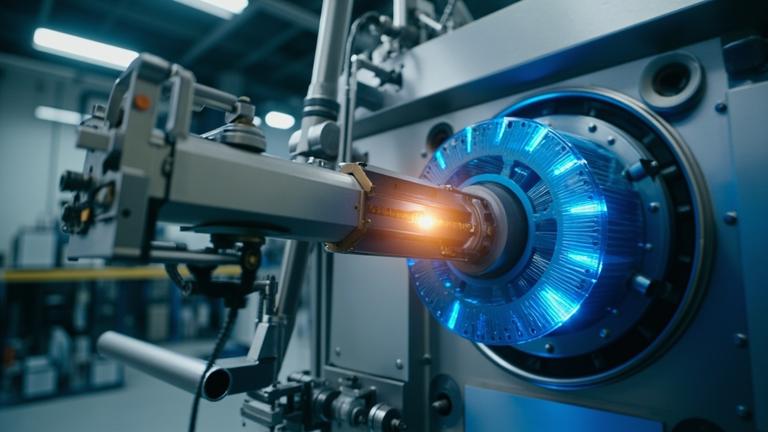
ETH Zurich undergraduates have demonstrated that university teams can now build and test rotating detonation engines — technology previously reserved for national labs.
- 3D-printed Inconel combustion chamber survived sustained detonation cycles
- The achievement lowers the barrier to entry for advanced propulsion research
- Student-built hardware is closing the gap with professional aerospace R&D
University-Scale Test The Problem
Rotating detonation rocket engines have been on the wishlist of every major space agency for decades. JAXA, NASA, and the Air Force Research Laboratory have poured millions into RDRE research. RTX and Astrobotic have thrown engineering teams at the problem. The payoff is clear: a continuous supersonic detonation wave spinning through a ring-shaped combustor could deliver step changes in thrust-to-weight and specific impulse. But the physics are brutal. The combustion front generates pressure spikes and temperatures that tear conventional injectors apart. The wave frequency hits 20,000 Hz. Getting the propellant mix, injector geometry, and chamber structure to survive more than a few milliseconds has eluded most programs.
University teams rarely get near hardware this aggressive. The costs are high, the safety requirements are uncompromising, and the failure modes are spectacular. The Solution
A 19-student team called Pegasus, operating under ETH Zurich's ARIS space program, decided to build a bi-liquid RDRE anyway. Their target was a 10% power improvement over conventional liquid engines. The team, made up of second- and third-year undergraduates, designed, printed, and test-fired the engine at Dübendorf airfield.
Mattia Röösli, who led injector development, used laser powder bed fusion to produce the prototype. LPBF was the obvious choice: it allowed internal channel geometries no conventional machining process could reach, and it cut part count dramatically. The team iterated on safety systems, oxidizer delivery, and chamber structure for months before the first hot fire. Previous ARIS cohorts acted as technical mentors, which kept the team from repeating known mistakes.
The injector had to survive the detonation wave's cyclic loading while maintaining precise propellant atomization. Röösli's design achieved three sustained detonation waves during test firing. That is not a full-duration burn, but it is a genuine detonation regime in a student-built engine, which places this result in rare company. The Results
Three sustained waves is a measurable result, not a headline. It proves the injector and chamber geometry can stabilize the detonation front long enough to collect data. For a university program running on a fraction of a government lab's budget, that is a meaningful threshold.
The broader value is in what the students actually learned. They worked through DfAM constraints on the LPBF system, ran FEA on parts that would see transient thermal loads no textbook covers accurately, and integrated propulsion, manufacturing, and systems engineering under real schedule pressure. Röösli put it plainly:
> "It's a mistake to think you can fully understand the topic before you start. You go step by step and help each other."
That attitude is what separates programs that produce PowerPoint from programs that produce hot fire data.
The economics are shifting. LPBF machines, propulsion electronics, and simulation licenses are cheaper than they were five years ago. More universities could run projects at this level if they chose to. Most do not. The Pegasus team's work is a useful benchmark for what is possible when a program commits to hardware-in-the-loop education.
Whether these students found the optimal injector geometry, or whether their 10% power target is achievable in a flight-weight configuration, remains open. The next ARIS cohort will inherit the test data and the damaged hardware. That is how engineering actually works.
Simon McLoughlin
Is this your company?
This article features your business. Claim it to add your logo, contact details, and a link to your website — or upgrade to reach more buyers.
Did you know 80% of Press Releases trigger AI content warnings? Reach out and the M4S team can assist.