
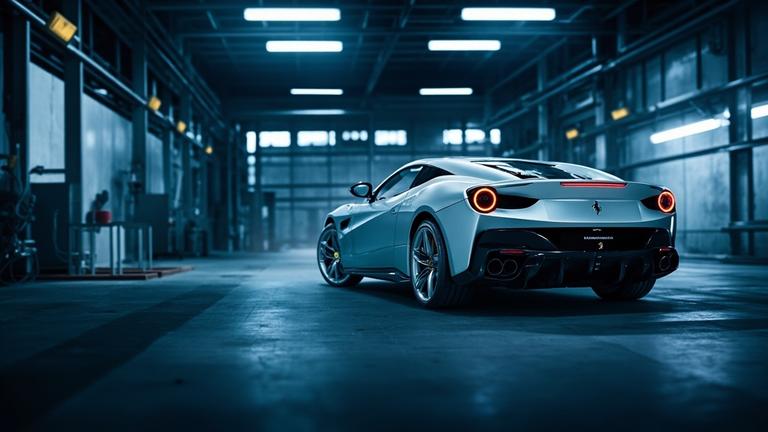
Ferrari's first EV demonstrates serious engineering capability with 1,035 hp, 800V architecture, and innovative casting techniques, but a Leaf-like exterior design undermines the $645K price tag. The powertrain and battery systems show mature thinking, while the chassis stiffness improvements are substantial.
- 1,035 hp from four F80-derived motors; 2.
Ferrari's first electric vehicle delivers on every performance metric that matters, but someone in Maranello made a curious call on the exterior styling. The Luce looks too much like a Nissan Leaf.
Let me be direct about the numbers. The Luce produces 1,035 hp from four radial-flux permanent magnet motors—borrowed from the F80 hybrid—and screams to 62 mph in 2.5 seconds. Top speed checks in at 194 mph. The 122 kWh battery pack accepts 350 kW DC fast charging, adding 70 kWh in 20 minutes. These figures place the Luce squarely in legitimate supercar territory.
Powertrain Architecture
The four-motor setup uses 800-volt architecture with motors spinning at 30,000 rpm up front and 25,500 rpm at the rear. Ferrari chose conventional radial-flux machines over the axial-flux motors Mercedes deployed in its recent GT 4-Door Coupe. I'll note that radial-flux is the more mature technology, and borrowing directly from the F80 program makes sense for a first EV.
The battery pack tells a more interesting story. SK On supplies the 210 high-nickel nickel-manganese-cobalt pouch cells, but Ferrari designed, validated, and built the pack in Maranello. Each module holds 14 cells with an aluminum heat sink between every cell pair for thermal management. Two lateral aluminum plates compress the cells, with upper and lower sheets laser-welded to form the module structure. Fifteen modules total—13 under the floor, two under the rear seats.
Structural Innovation
Here's where Ferrari's engineers deserve credit. The Luce uses three large-scale aluminum castings for the main structure, including what Ferrari claims is the largest hollow monobloc casting ever produced at Maranello. All from recycled aluminum.
The structure achieves 25% greater bending rigidity and 35% greater torsional rigidity compared to previous applications. More practically, the front axle, battery, and rear axle sections can be removed independently, which matters for serviceability in a vehicle this expensive.
The Problem
The Luce's exterior design draws unwanted comparisons to the Nissan Leaf. The hatchback profile and similar launch colors created a visual echo that Ferrari's marketing team probably didn't anticipate. The false hoodline—an aerodynamic bridge over the actual hood—doesn't help distinguish the profile.
The cabin offers a partial correction. Physical switches and knobs provide tactile feedback that touchscreens can't match. Ferrari also developed an interesting sound system using guitar-style pickups to capture and amplify the EV's natural acoustics, similar to Dodge's Fratzonic approach.
The Verdict
Ferrari built a technically impressive first electric vehicle. The powertrain delivers, the battery thermal management is sophisticated, and the casting approach shows real manufacturing ambition.
But design teams missed an opportunity to give the Luce visual identity that communicates "Ferrari" rather than "generic EV hatchback." At $645,000, buyers expect a car that looks like $645,000.
The Luce proves Ferrari can build a competitive EV platform. Whether the styling team was asleep or simply overmatched by the Sir Jony Ive influence remains unclear. The engineering stands on its own. The aesthetics need revision before I would park one in my driveway.
Simon McLoughlin
Is this your company?
This article features your business. Claim it to add your logo, contact details, and a link to your website — or upgrade to reach more buyers.
Did you know 80% of Press Releases trigger AI content warnings? Reach out and the M4S team can assist.