
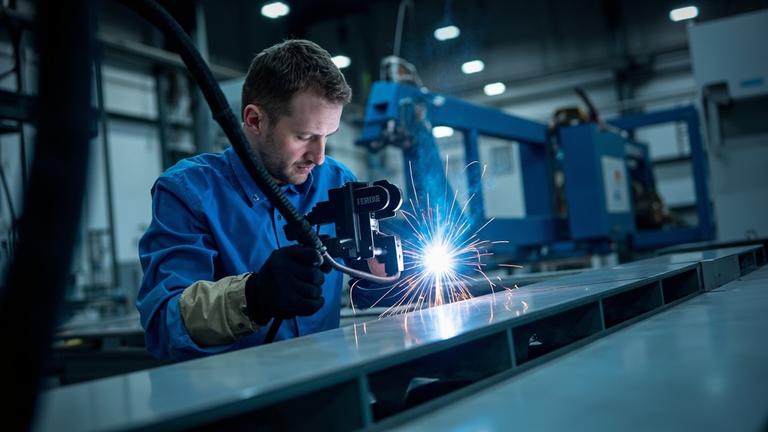
This launch signals Forney's intent to compete more aggressively in the entry-to-mid welding segment with a coherent product family tied to a clear upgrade path
- The TruSet technology addresses setup time concerns but warrants hands-on evaluation before procurement decisions
Forney Industries launched its X-Series family of welders and plasma cutting equipment, targeting makers, contractors, and fabrication shops that need reliable performance without enterprise pricing. The lineup occupies the 100A to 160A range, complementing Forney's existing 180A to 250A platforms and creating a documented upgrade path for customers moving up from starter machines.
The X-Series arrives with four welder models and one plasma cutter, all built around Forney's TruSet technology, which automatically optimizes settings based on material thickness and wire diameter. The 125 FCx flux-cored unit and 140 MIGx inverter-based MIG welder both use this system to reduce setup complexity. I suspect this is the main selling point for the target buyer who wants capability without spending time dialing in parameters.
Duty Cycle Details
The technical specifications reveal the typical tradeoffs in this price class:
The 100 STx delivers Stick at 30% duty cycle at 80A and TIG at 30% at 85A. The 160 STx runs 120V Stick at 30% @ 80A and 240V Stick at 25% @ 160A, with the LED display providing visibility that older designs often lack. The 140 MPx multi-process machine handles MIG at 30% @ 90A, Stick at 30% @ 80A, and TIG at 20% @ 110A, covering most shop scenarios in a single unit.
TruCut Plasma Cutter Specs
The TruCut plasma cutter accepts standard household power and delivers 1/4-inch clean cuts with 3/8-inch severance capability. TruSet again handles optimization based on thickness input. Duty cycle sits at 30% @ 90A, which aligns with the welding equipment for consistent shop workflow.
Market Position and Value
All units carry a three-year warranty and CSA certification, addressing durability concerns for buyers who question whether budget equipment can handle daily use. The pricing remains unstated in the announcement, which makes direct comparison difficult against Lincoln Electric, Miller, or ESAB equivalents in this amperage class.
Jason Mahugh, Forney's director of engineering and technical services, said the company focused on the 100A to 160A range specifically to avoid feature creep. "We didn't try to pack in capabilities that drive up cost without helping the target user," he noted.
The Upgrade Path Question
Forney's strategy here is clear: capture buyers at the entry point and give them a reason to stay with the brand as demands increase. The 180A to 250A platforms already exist above this lineup, so dealers can merchandise a complete range from a single vendor. Whether the TruSet technology and build quality justify that upgrade path remains to be seen in long-term field reports.
The X-Series fills a gap in Forney's catalog and gives the company a competitive entry in the crowded mid-range welding market. Engineers evaluating these for maintenance shops or light fabrication should compare duty cycle performance under actual conditions rather than relying on specifications alone.
Simon McLoughlin
Is this your company?
This article features your business. Claim it to add your logo, contact details, and a link to your website — or upgrade to reach more buyers.
Did you know 80% of Press Releases trigger AI content warnings? Reach out and the M4S team can assist.