
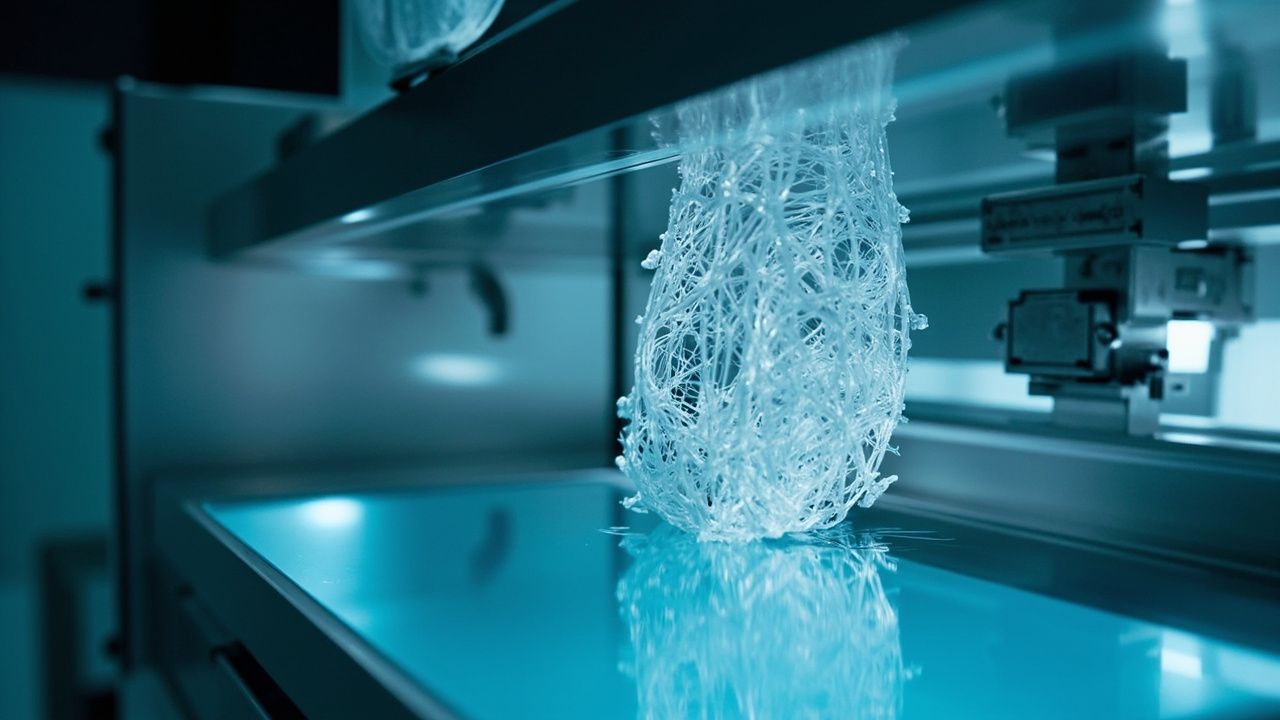
This case study illustrates how biodegradable scaffold design for soft tissue reconstruction requires solving tightly coupled problems: material degradation rate, mechanical support duration, and vascular integration timing must all align with biological healing processes
- For manufacturing engineers, the patient-specific 3D printing workflow presents real questions about scalability and quality control
The Problem: A Clinical Need With No Good Answer
Every year, hundreds of thousands of women undergo lumpectomy, the surgical removal of a cancerous breast tumor. Most walk away cancer-free. Many also walk away with permanent contour deformities and asymmetry that current reconstructive options fail to address adequately.
I spoke with Katie Weimer, CEO and Co-Founder of GenesisTissue, about the technical challenges driving this unmet need and how her team is approaching it.
Standard silicone implants were not designed for the irregular voids left by partial resection, particularly after radiation therapy, which hardens and damages surrounding tissue. For full-breast reconstruction, they carry well-documented risks: infection, capsular contracture, rupture, and malposition. The gap has persisted for decades.
"Surgeons often have no choice but to leave defects uncorrected, resulting in contour deformities, asymmetry, and ultimately a diminished quality of life," Weimer said.
The Solution: A Degradable Scaffold That Buys Time for Fat Grafts
GenesisTissue's lead product, Regenerative Breast Tissue (RBT), is a bioprinted, personalized, biodegradable scaffold designed to fill a soft tissue void, support a fat graft, and ultimately make way for the body's own tissue to take over.
The scaffold maintains shape and volume of the reconstructed area while the fat graft takes hold. Its porous architecture supports fat cell survival and vascular ingrowth, the formation of new blood vessels essential for long-term tissue viability.
The technical specifications are where this gets interesting. The scaffold provides structural support for three to six months, enabling fat retention and tissue maturation, and fully biodegrades over six to twelve months, leaving behind only the patient's regenerated adipose tissue. No permanent foreign body remains.
Personalization is central to the approach. Because lumpectomy defects vary enormously in size, shape, and location, a one-size-fits-all scaffold is unlikely to produce optimal outcomes. GenesisTissue envisions a workflow in which each patient's defect is imaged, modeled, and used to generate a custom-printed scaffold matched to that specific void.
Manufacturing uses medical-grade, light-based 3D printing, which Weimer says enables the precision required for patient-specific geometry while maintaining scalability.
The Core Challenge: Degradation Timing
The technical problem that has demanded the most from the team is degradation timing. Weimer is precise about this.
"The scaffold needs to remain strong and flexible long enough to physically support and protect the fat graft, while also degrading in sync with fat graft maturation and vascular integration," she said. "If it degrades too quickly, structural support is lost before the tissue stabilizes; too slowly, and it can interfere with regeneration."
Getting that timing right is difficult to design for in the laboratory and even harder to verify. Standard in vitro degradation tests do not accurately reflect what happens inside a fat-rich environment, which means extensive in vivo validation is required before clinical translation.
Where This Stands
GenesisTissue is early-stage. The full workflow from imaging to printed scaffold is still being finalized, and regulatory pathways remain to be mapped. Weimer acknowledges these are open questions the field has yet to fully reckon with.
What the company has demonstrated is a technically coherent approach to a problem that has resisted previous solutions. Whether the degradation timing can be consistently controlled across the variability of real patients is the question that will determine whether RBT moves past the prototype stage.
Simon McLoughlin
Is this your company?
This article features your business. Claim it to add your logo, contact details, and a link to your website — or upgrade to reach more buyers.
Did you know 80% of Press Releases trigger AI content warnings? Reach out and the M4S team can assist.