
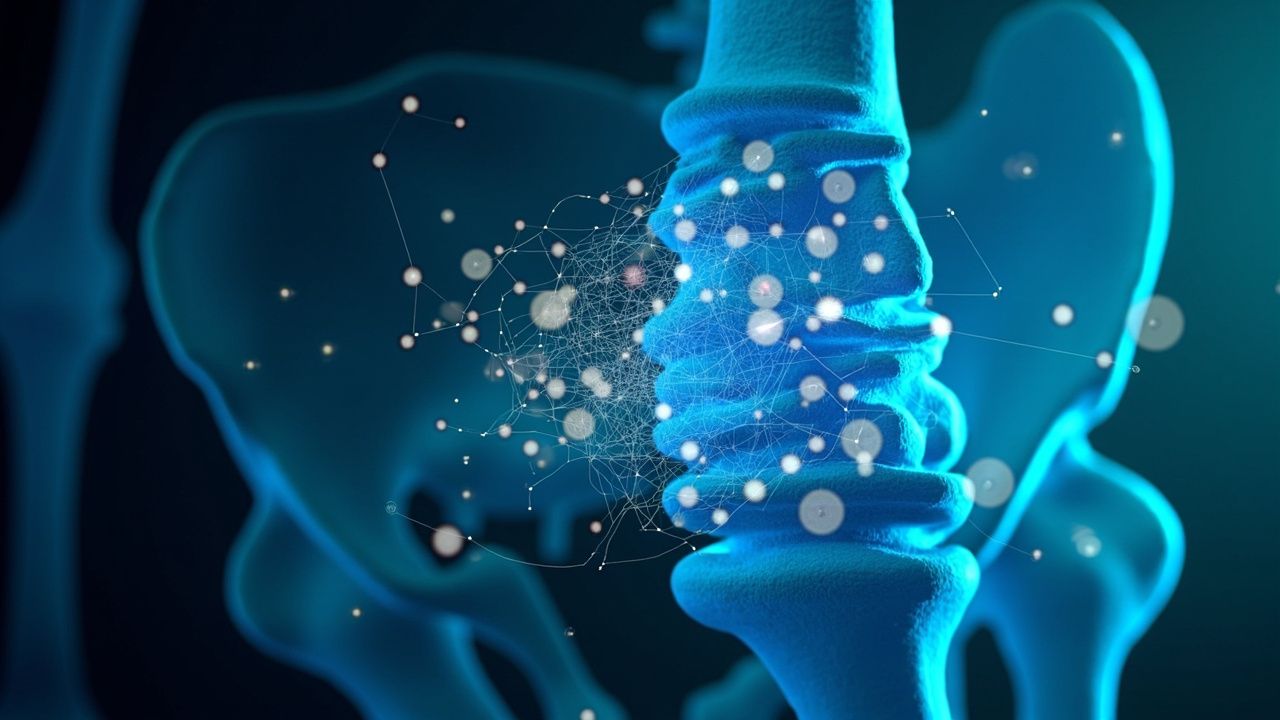
Ossevo represents a departure from conventional topology optimization by incorporating biological feedback into the design loop
- For engineers evaluating next-generation implant platforms, the computational approach addresses stress shielding directly rather than managing its consequences
- The Hybrid Cellular Automata method's field-driven output offers a quantifiable alternative to geometry-first design philosophies
Problem: Revision Rates Stagnant Despite Design Advances
Orthopedic implant revision rates have held steady between 10% and 20% for decades, a failure of engineering logic more than material science. Dr. Sajjad Raeisi, Founder and CEO of GenMat, puts it bluntly: the field has been solving the wrong problem.
Standard titanium implants carry stiffness five to ten times greater than human bone. That disparity causes the implant to absorb mechanical load that surrounding bone tissue should carry. Without that stimulus, bone resorbs. The result is stress shielding, implant loosening, and revision surgery.
successive generations of design attempts have failed to close this gap. Porous coatings improved osseointegration. CAD introduced patient-specific geometry. Metal additive manufacturing enabled lattice structures. Triply periodic minimal surfaces offered geometrically smooth architectures. Topology optimization identified efficient material distribution.
Each approach shares one fundamental flaw: none incorporates biological feedback into the design process. Topology optimization minimizes compliance, the very property driving stress shielding. Lattice structures, however refined, remain geometrically uniform and unresponsive to local mechanical demands of individual patient anatomy.
"None of the current design approaches incorporates biological feedback into the process. That is the fundamental gap we are working to close," said Raeisi.
Solution: Bio-Inspired Structural Optimization
Ossevo, short for osseous evolution, replicates bone's own regulatory mechanism computationally. Under normal physiological conditions, bone continuously remodels in response to local mechanical stimuli, adding material in high-stress regions and resorbing it where load is minimal. This adaptive process produces a spatially graded architecture precisely calibrated to its mechanical environment.
The platform uses the Hybrid Cellular Automata method. Rather than minimizing a compliance function as topology optimization does, Ossevo minimizes deviation from a target mechanical stimulus across all elements of a finite element model. The design seeks the same uniform mechanical response bone seeks through remodeling. The result is a field-driven lattice structure where local geometry, pore size, wall thickness, and strut diameter vary continuously in response to the mechanical field.
Implications for Device Manufacturers
GenMat's approach shifts implant design from geometric approximation to functional replication. By targeting mechanical stimulus distribution rather than structural efficiency, the platform addresses the root cause of stress shielding rather than its symptoms.
The platform targets orthopedic device manufacturers and surgical planning teams working on complex reconstruction cases. GenMat presented at AMA Healthcare's June 4th 3D printing spotlight event, where Raeisi outlined the computational framework underlying the approach.
Simon McLoughlin
Is this your company?
This article features your business. Claim it to add your logo, contact details, and a link to your website — or upgrade to reach more buyers.
Did you know 80% of Press Releases trigger AI content warnings? Reach out and the M4S team can assist.