
This launch validates HP MJF as a viable production pathway for mid-market performance footwear, with the 180-day development cycle being the critical metric for supply chain planning
- The ~$250 price point breaks new ground for 3D printed performance shoes, though the 75% energy return claim requires independent verification before use as a design benchmark
The Challenge
Decathlon's Kiprun brand wanted to move beyond the premium-only positioning that dominated early 3D printed footwear. Most high-profile launches clustered either at collector-tier pricing or limited-edition drops. Kiprun aimed for a performance product at a price point accessible to serious amateur runners.
The technical constraint is well-known: MJF-produced lattice midsoles offer superior energy return characteristics compared to EVA foam, but production economics have historically excluded the mid-market segment.
The Solution
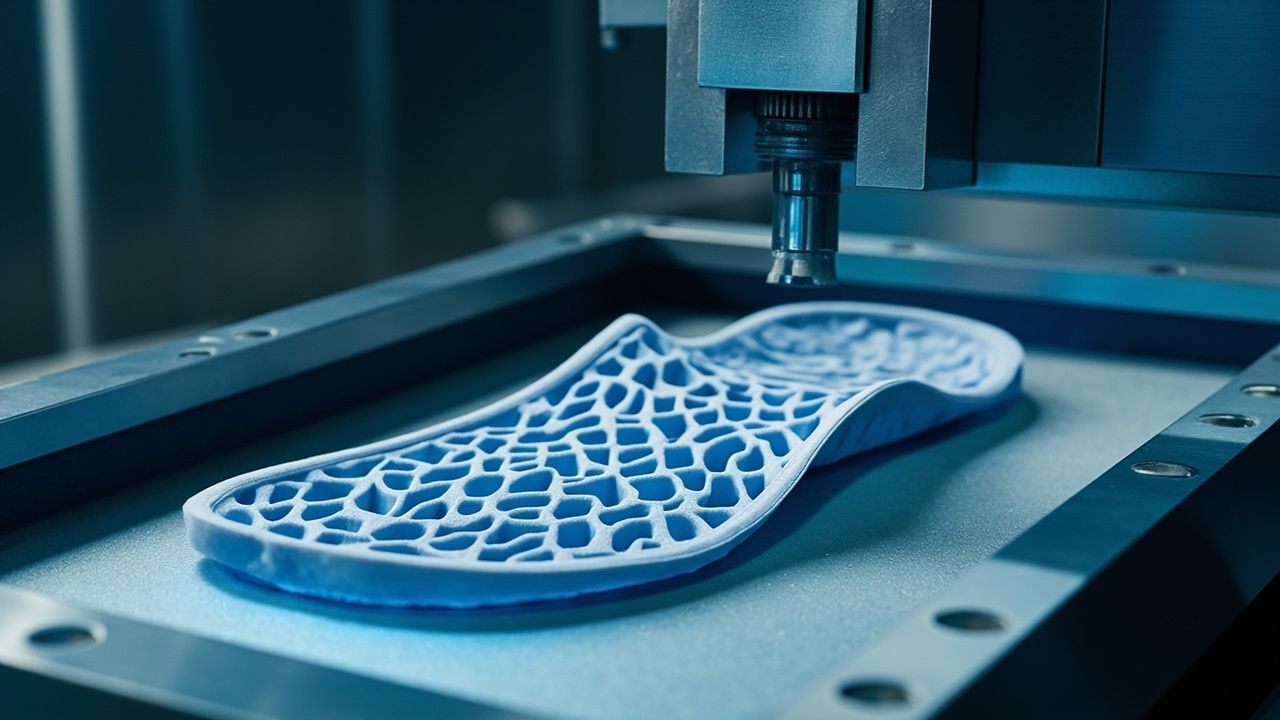
Kiprun developed a hybrid construction combining a conventional knitted upper with integrated lacing and a 3D printed midsole. This approach reduces additive manufacturing scope to the component where it delivers the most performance value.
The midsole uses HP Multi Jet Fusion with a proprietary thermoplastic elastomer material. The variable-density lattice structure distributes cushioning according to stride patterns. The manufacturing partnership involved SomethingAdded, a Barcelona-based MJF footwear specialist, alongside Decathlon's Shenzhen innovation hub.
From concept to finished product: 180 days.
The Numbers
The KIPNEXT 3D claims 75% energy return, compared to 50–65% commonly cited for EVA foam midsoles. I should note this figure remains unverified by independent testing. The shoe launched at approximately $250, exclusively in select Decathlon stores in China, with limited quantities available. No timeline for broader availability has been announced.
What This Means for Engineers
The 180-day development cycle is the real story here. That turnaround time makes additive manufacturing viable for seasonal product cycles that previously ruled it out. If Decathlon can take a concept to production in six months, the economics for mid-volume runs become substantially more attractive.
I see the hybrid construction approach as a deliberate cost-control decision. Fully additive footwear construction remains expensive; combining MJF midsoles with conventional uppers lets brands capture lattice performance benefits without full-additive pricing. This pattern will likely become standard for performance footwear unless material costs drop significantly.
The 75% energy return figure needs verification before I would spec this in a design. Decathlon has a track record of aggressive performance claims that don't always survive independent testing. I'd want to see published third-party data before considering this a design reference point.
The $250 price point breaks below the $300+ threshold that has limited 3D printed footwear to niche markets. If production scales and costs compress further, this positioning could accelerate adoption across mid-market performance categories.
Nike's Air Max 1000 and Gucci's scaled Cub3d line (now five colorways, 70%+ plant-based materials) show the industry is moving beyond experimentation. Kiprun's entry signals that mid-market brands are now treating additive manufacturing as a production capability rather than a novelty. That's a meaningful shift.
Simon McLoughlin
Is this your company?
This article features your business. Claim it to add your logo, contact details, and a link to your website — or upgrade to reach more buyers.
Did you know 80% of Press Releases trigger AI content warnings? Reach out and the M4S team can assist.