
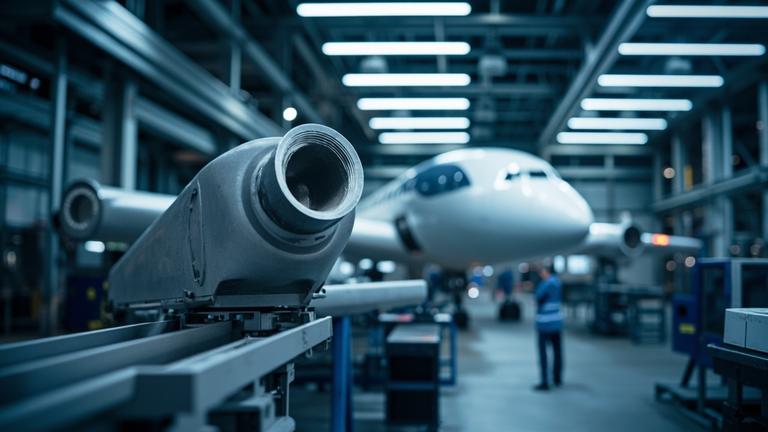
This collaboration marks a significant step in the industrialisation of additive manufacturing for high-criticality aerospace components. The focus on qualification, standardisation, and integration into Airbus' production processes highlights the technology's potential to transform aerospace manufacturing.
Problem
The aerospace industry faces significant challenges in producing large, high-criticality titanium components with traditional manufacturing methods. These methods often result in high material waste, long lead times, and complex certification processes. The Airbus A350's Lower Frame Fitting, a critical structural component, exemplifies these challenges. Traditional manufacturing techniques struggle to meet the stringent requirements for weight reduction, strength, and certification standards set by aviation authorities like EASA and the FAA.
Solution
Norsk Titanium and Airbus have entered into a new Cooperation & Research Agreement (CRA) to address these challenges through additive manufacturing. The partnership focuses on the industrialisation and qualification of Norsk's Rapid Plasma Deposition (RPD) technology for producing the Lower Frame Fitting at Norsk's Plattsburgh Production Facility.
Key elements of the collaboration include:
- Technology Scaling: The agreement aims to mature RPD technology for additional applications, particularly fatigue-critical structural elements. This involves extensive technical qualification of titanium wire and industrial process validation.
- Material and Process Qualification: The partners will work on standardising these innovations according to Airbus specifications. This includes interfacing with the Airbus DED project team to ensure coordination across engineering, airworthiness, and operational implementation at facilities like Saint Eloi and Varel.
- Integration into Airbus Standards: The CRA establishes a framework for integrating RPD into Airbus' core material, process, and industrial standards. This is supported by the recent FAA certification of the Lower Frame Fitting, which underscores the technology's readiness for broader adoption.
Norsk Titanium will also supply an RPD machine to Airbus' facility in Varel, Germany, to jointly evaluate manufacturing processes, controls, and validation data. This aims to transition from part-specific qualification to broader process-based methodologies for specific titanium products.
Results
The collaboration has already achieved significant milestones:
- Certification: The Lower Frame Fitting has been certified by both EASA and the FAA, making it the largest and highest-classification additively manufactured component for an aerostructure in commercial aerospace.
- Industrialisation Progress: The partnership is moving beyond prototyping and into industrial-scale production. This is supported by the Master Supply Agreement signed in 2024 to support A350 production.
- Cost and Time Savings: By integrating RPD into Airbus' production processes, the collaboration aims to deliver substantial cost, lead-time, and material savings. This aligns with the aerospace industry's requirements for efficiency and sustainability.
"Together with the recent FAA certification of the Lower Frame Fitting for the Airbus A350, this represents an additional endorsement of our RPD technology and another step toward expanding the adoption across commercial aircraft programs," said Fabrizio Ponte, CEO of Norsk Titanium.
The collaboration is structured around four key work packages, including technology scaling, material and process qualification, and material expansion behind titanium. This comprehensive approach ensures that the benefits of additive manufacturing are fully realised in the production of critical aerospace components.
Is this your company?
This article features your business. Claim it to add your logo, contact details, and a link to your website — or upgrade to reach more buyers.
Did you know 80% of Press Releases trigger AI content warnings? Reach out and the M4S team can assist.