
Additive electronics manufacturing remains a reliability challenge, but integrated build-correct platforms are closing the gap toward 100% yield in ways traditional workflows cannot match
- For engineers evaluating hybrid manufacturing systems, the economic case now hinges on downtime costs and supply chain reliability rather than throughput speed
The Reliability Problem
Electronics manufacturing tolerates almost no defects. A short, an open, a misplaced trace, and the entire assembly fails. This contrasts sharply with structural parts, where minor imperfections can often be tolerated. For defense contractors and aerospace manufacturers operating in remote or hostile environments, a failed circuit board means weeks or months waiting for replacements. Supply chains in those conditions are unpredictable, and downtime costs real money and real mission capability.
"The goal is simply 100% yield," said Ken Church, CEO of nScrypt. "If you have a defect in electronics, it's not going to work."
Traditional manufacturing handles this problem by separating build from inspection. Defects get caught after production, parts get rejected, and the process starts over. This workflow works fine when you're batch-producing thousands of identical boards and can afford scrap rates. It falls apart when you need one-off repairs in Djibouti or Norway.
The Solution: Factory in a Tool
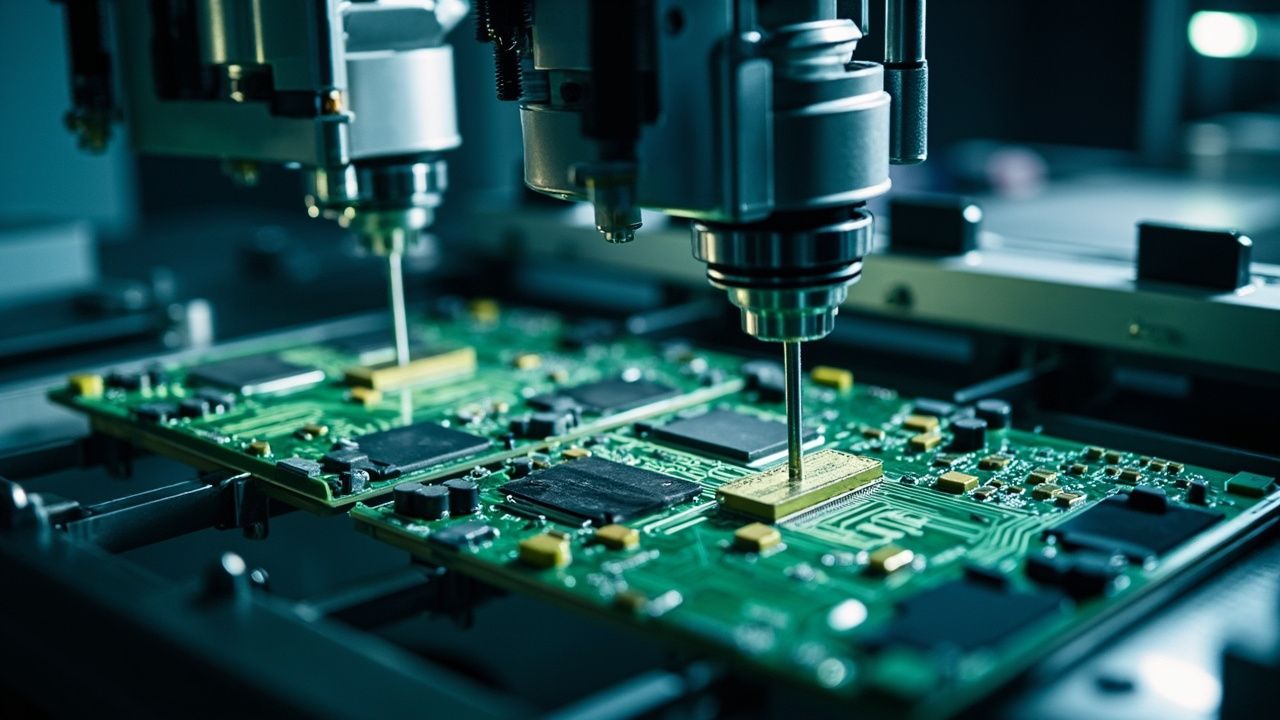
nScrypt's approach bundles multiple manufacturing operations into a single platform. Their systems perform additive deposition, subtractive correction, pick-and-place operations, inspection, and electronics integration, all in one machine.
"We're not just depositing material layer by layer," Church told me during a facility visit. "A single machine can handle the full workflow. That's why we call it 'factory in a tool.'"
The critical piece is the integration of inspection directly into the build process. Each layer gets evaluated as it's created. If something drifts out of spec, the system intervenes in real time, corrections happen immediately, and layer deposition continues. There's no waiting for a post-build inspection to catch the problem.
This hybrid build-correct workflow generates substantial process data. Layer-by-layer measurements create a rich dataset for machine learning analysis, which Church sees as the path toward fully reliable additive electronics.
"The beautiful part of machine learning is it likes data," Church said. "It thrives on data. By collecting and analyzing layer-by-layer information, we can improve consistency and move closer to reliable additive electronics. We're knocking on the door."
nRugged: Field Deployment
nScrypt's nRugged system takes the platform beyond the factory floor. Designed for harsh and remote conditions, the system enables on-site repair of electronic assemblies without waiting for replacement parts to arrive through supply chains.
The unit has already seen field deployment in multiple locations: Djibouti, Norway, Hawaii, and is headed to Japan. During my visit, the system was present at the Orlando facility, which made the deployment claims more concrete.
"In many cases, that difference can be measured in weeks or months," Church said. "In well under an hour, you'll fix that circuit. Which would've taken months to get a replacement."
For military applications where electronics failures can strand platforms or compromise operations, this shift from weeks to hours represents meaningful capability change. Logistics chains shrink to a machine, an operator, and whatever materials fit in the field kit.
What This Means
The engineering trade-off here isn't subtle. Bringing multi-process manufacturing capability into a single system sacrifices some of the specialization that makes high-volume production lines efficient. In exchange, you get process integration, real-time correction, and deployment flexibility that traditional equipment can't match. That trade-off makes sense for low-to-medium volume electronics where defects are expensive and supply chains are unreliable.
Church's team is still pushing toward their 100% yield target, but the integration path is working. The hybrid platform approach, combined with machine learning on process data, puts that target within reach for a specific market segment: defense contractors, aerospace manufacturers, and any operation that needs reliable electronics in locations where backorders aren't acceptable.
Simon McLoughlin
Is this your company?
This article features your business. Claim it to add your logo, contact details, and a link to your website — or upgrade to reach more buyers.
Did you know 80% of Press Releases trigger AI content warnings? Reach out and the M4S team can assist.