
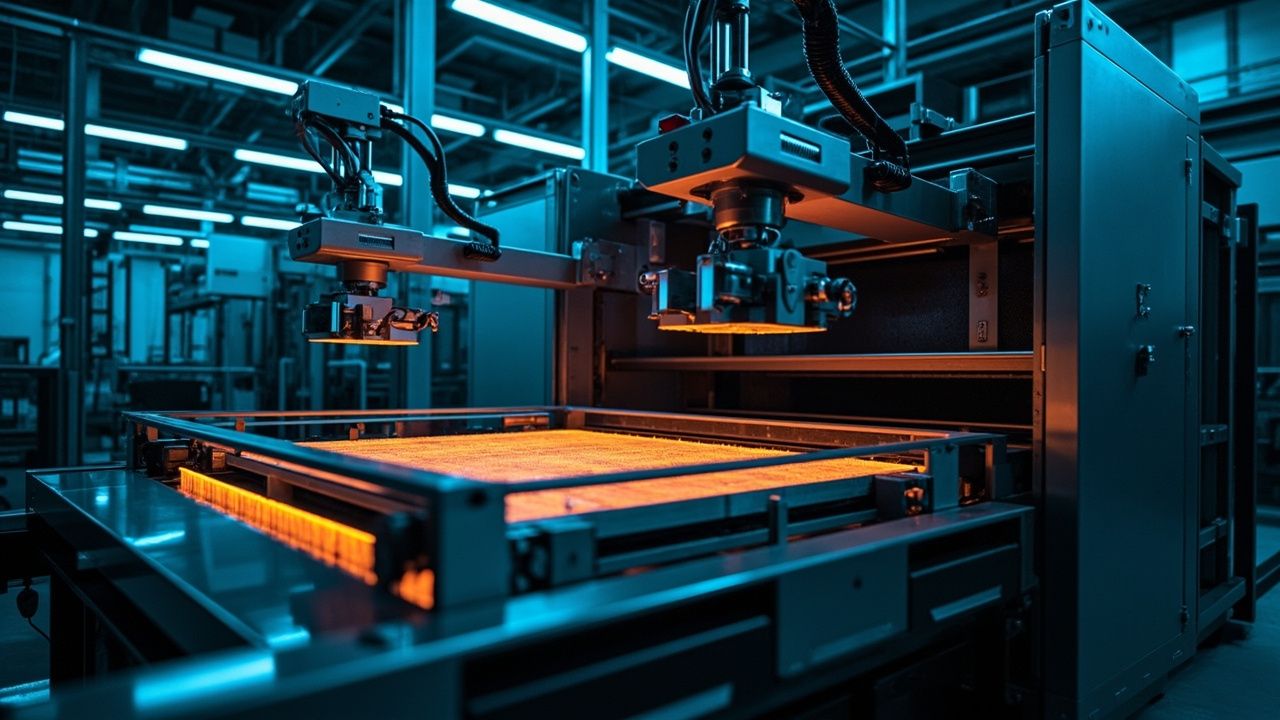
ORNL's automated thermal controller represents a practical advancement in large-format 3D printing quality control, moving from human-mediated monitoring to closed-loop thermal management
- The technology addresses a real manufacturing bottleneck, though commercial availability remains uncertain
The persistent problem with industrial-scale plastic 3D printing has always been layer adhesion. When printing massive components, maintaining precise thermal conditions across hundreds of layers requires constant human oversight. Workers stand beside multi-million-dollar machines for hours, watching temperature readings and adjusting speeds manually. It's tedious, expensive, and introduces human error into a process that demands precision measured in degrees.
The Problem: Manual Monitoring Cannot Keep Pace
Large-format additive manufacturing deposits heated plastic composite through robotic nozzles, building parts layer by layer. Each layer must bond properly to the one below while maintaining structural integrity. The thermal window is narrow: too hot and layers bleed together; too cold and delamination occurs. Traditional systems rely on operator intervention when drift appears, which means defects are often caught too late.
ORNL researchers identified this as a bottleneck limiting widespread industrial adoption. The team, led by Kris Villez, set out to build a controller that could perceive thermal conditions and respond without human involvement.
The Solution: Sensor Fusion and Real-Time Adjustment
The system combines multiple sensor inputs with AI-driven analysis. A ring of affordable thermal cameras mounts directly around the print nozzle, providing continuous temperature readings of deposited material. The controller tracks nozzle position, print speed, and material temperature simultaneously.
When the computer vision system detects temperature drift, it automatically adjusts print speed to bring the process back into spec. The controller does not simply flag anomalies; it corrects them in real time.
"It controls the process almost like a human would: by observing and nudging the setting until it reaches the desired outcome," Villez said. His team partnered with University of Tennessee graduate student Chris O'Brien on the project.
Validation: Hexagon Test Reveals Controller Capability
Researchers printed a hexagonal part larger than a truck tire to test the system under adverse conditions. The initial print parameters started deliberately slow, causing material to arrive approximately 30% below optimal bonding temperature. The controller detected the deviation immediately and increased print speed automatically, restoring proper thermal conditions within seconds.
The system identified temperature shifts of just a few degrees. This sensitivity matters because even minor thermal variation ruins finished parts, and rework costs in large-format printing are substantial.
Critically, the controller requires no retraining for new designs, materials, or part geometries. The team also developed a machine-learning-based digital twin for safe experimentation before physical production runs.
Technical Specifications
The foundation builds on prior ORNL research with Purdue, University of Maine, and University of Tennessee-Knoxville, which demonstrated 15% print speed deviation detection using thermal imaging and statistical modeling. The new system advances beyond detection to automated correction.
"We'd love this to work like baking bread: You set the oven temperature, put in your dough, and return when the timer goes off," Villez said. "You don't have to monitor the oven temperature in real time."
Funding came from DOE's Advanced Materials and Manufacturing Technologies Office, with contributions from researchers Katie Copenhaver and Alex Roschli.
Practical Implications for Manufacturers
Skilled operator time currently represents a significant cost center in large-format additive manufacturing. This controller frees those workers for higher-value tasks while enabling longer unattended operation cycles. Potential applications include refrigerated shipping containers, boat hull molds, structural building walls, and aircraft components.
The system remains in research phase, but the architecture uses commercially available thermal cameras and standard industrial interfaces, which suggests a viable path to commercial deployment.
Simon McLoughlin
Is this your company?
This article features your business. Claim it to add your logo, contact details, and a link to your website — or upgrade to reach more buyers.
Did you know 80% of Press Releases trigger AI content warnings? Reach out and the M4S team can assist.