
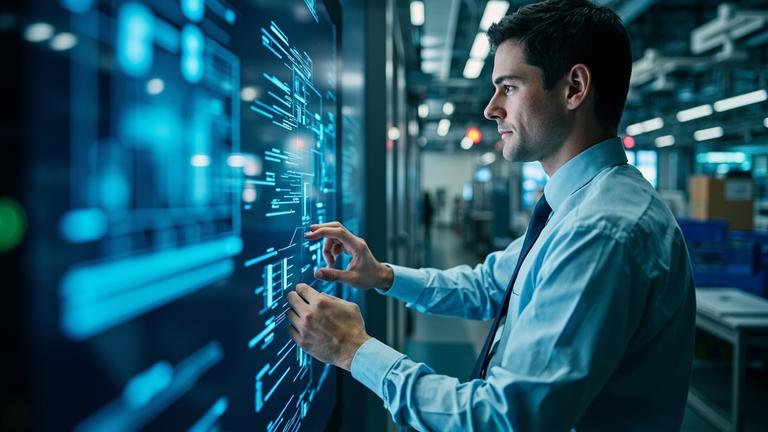
Physical AI is moving from digital twins and simulations into real factory environments. • Edge deployment means AI models run on factory floors, not in cloud data centers
- Latency drops from seconds to milliseconds — critical for real-time control loops
- The challenge is robustness: factory conditions break lab-trained models quickly
Compute Is the Bottleneck.
Artificial intelligence has spent decades in the digital realm. Early systems identified objects and parsed speech. Generative models learned to write code and generate images. Agentic systems now coordinate workflows across software environments. The next shift is physical. AI is leaving the screen and interacting directly with machinery, warehouse floors, and production lines. That transition changes everything about how these systems are built and where they run. From Perception to Action
For years, AI in robotics meant perception. Cameras fed data into models that recognized objects, mapped spaces, and flagged anomalies. But the action layer, the part that actually moved the arm or steered the vehicle, relied on hard-coded rules. AI understood the environment. It did not control the response.
Physical AI closes that loop. Machines must now interpret sensor data, reason about what they see, and act on it in the same cycle. Conditions change in milliseconds. A conveyor belt jams. A pallet shifts. A human steps into the workspace. The system cannot wait for a cloud round-trip to decide what to do next.
The gap between current capability and real autonomy is obvious in everyday examples. A warehouse cleaning robot hits a stray cable, stalls, and pings maintenance. A physical AI system would identify the cable, route around it, and flag the hazard for review. The difference is not incremental. It is the gap between semi-automated and fully autonomous operation.
That level of responsiveness demands intelligence on the device itself. Edge compute is not optional here. It is the architecture. Why the Edge Becomes Non-Negotiable
Cloud infrastructure still matters. Training, model updates, and fleet-wide analytics belong at the center. But executing physical decisions from a distant server introduces failure modes that are unacceptable in production environments.
Latency is the obvious one. A 200-millisecond delay in a cloud response is irrelevant for a chatbot. In a robotic arm collision-avoidance loop, it is a safety incident. Connectivity gaps compound the problem. Factories run on networks that drop, congest, or get reconfigured. Physical AI cannot pause when the Wi-Fi hiccups.
Running models locally solves this. It also keeps proprietary operational data inside the facility, reduces jitter in control loops, and lets systems operate through outages. The model that emerges is hybrid. Cloud trains. Edge executes. The boundary between them is becoming a core design decision for robotics engineers. The Humanoid Distraction
Humanoid robots get the headlines. The engineering reality is more grounded.
The bottleneck in physical AI is not reasoning capability. Perception models and planning algorithms are improving fast. The constraint is mechanical. Actuators, joints, end effectors, and power systems still lag what biology does effortlessly. A human hand has 27 degrees of freedom and runs on glucose. Replicating that in metal and silicon at industrial cost and reliability remains unsolved.
The near-term deployments are not humanoids. They are specialized systems. Autonomous forklifts. Bin-picking arms. Mobile manipulators that handle specific material-handling tasks. These machines do not need to walk or gesture. They need to pick, place, sort, and transport with precision, at speed, without breaking down.
That is where the investment is flowing. Not into general-purpose androids, but into narrow, reliable, edge-deployed systems that solve defined problems on factory and warehouse floors. What This Means for Engineers
Physical AI forces a rethinking of system architecture. Engineers designing these platforms face a new set of constraints. Compute budgets are tight on the device. Power and thermal envelopes are real. Models must be distilled, quantized, and optimized for inference at the edge without sacrificing the reasoning quality that makes physical autonomy possible.
The winners in this space will be the teams that solve the integration problem. Not just better AI models. Not just better hardware. The tight coupling between sensing, reasoning, and actuation, running reliably in uncontrolled environments, at cost points that justify deployment over human labor.
That is the engineering challenge. The rest is marketing.
Simon McLoughlin
Is this your company?
This article features your business. Claim it to add your logo, contact details, and a link to your website — or upgrade to reach more buyers.
Did you know 80% of Press Releases trigger AI content warnings? Reach out and the M4S team can assist.