
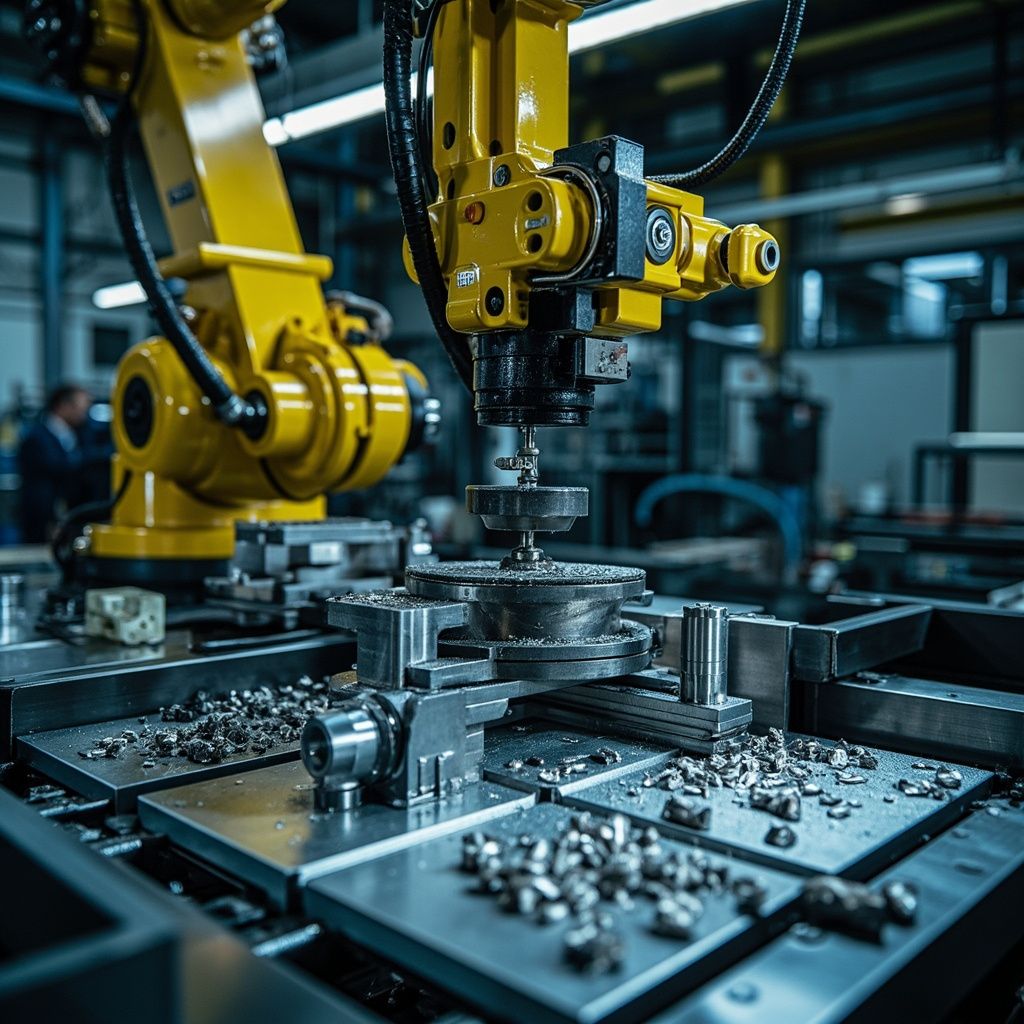
Robotic CNC integration has moved from experimental to economic for mid-volume production shops. The ROI timelines are short enough that waiting no longer makes sense for most manufacturers with ongoing labor constraints.
- FANUC ROBODRILL integration: 33% efficiency gain, 100 to 150+ parts per shift, 33-week ROI payback
- Universal Robots UR5e: 23% cost reduction, 43% throughput increase, 30-micron repeatability
- KUKA KR Quantec Nano with KUKA.CNC: G-code native programming, multi-tool automated cells for aerospace
- Deloitte projects 1.
The manufacturing labor crisis has reached a point where running a CNC machine without robotic tending is becoming a competitive liability, not a choice.
The Problem That Forced Change
Manual CNC tending creates three compounding problems. First, skilled machinists are becoming scarce. Deloitte estimates 1.9 million of the 3.8 million manufacturing positions that need filling by 2033 will remain vacant due to skills gaps. Second, CNC machines sit idle outside staffed shifts. These capital-intensive assets cost tens of thousands of dollars and generate no revenue when operators go home. Third, human loading introduces variability. Operator fatigue, inconsistent grip, and minor misalignments accumulate over a shift and surface as scrap or rework.
Robotic CNC integration addresses all three simultaneously. A single arm now handles part orientation, in-process inspection, deburring, and inter-machine transfer within one automated cell. That removes entire labor-dependent segments from the production chain and enables lights-out manufacturing running material changes autonomously overnight and through weekends.
FANUC: Turnkey Integration with Proven ROI
FANUC designs its robotic arms specifically for its ROBODRILL vertical machining centers. The 2024 ROBODRILL α-D28LiB5ADV Plus Y500 pairs with the R-50iA controller, which includes an embedded vision system for part recognition and placement verification.
APT Manufacturing Solutions documented a 33% efficiency gain on a FANUC-tended ROBODRILL line. Output climbed from 100 to more than 150 parts per eight-hour shift, with full ROI achieved in 33 weeks. That's under nine months for a system that runs unsupervised through weekends.
Universal Robots: Cobots for Space-Constrained Shops
Universal Robots built its cobot lineup to work alongside people without safety caging. That matters for small-to-midsize shops that can't dedicate floor space to full robot cells.
Toolcraft, a Seattle machine shop, deployed a UR5e on a three-operation CNC task for a medical device component. The UR5e's 30-micron repeatability enabled multi-threaded parts to be accurately placed across three sequential fixtures. Result: 23% reduction in production costs and 43% increase in throughput. A single cobot effectively replaced the labor of two operators across those three stations.
KUKA: High-Precision for Aerospace and Defense
KUKA built its reputation on high-payload, high-precision systems. Its KUKA.CNC software allows robots to be programmed in G-code, the same language CNC operators already know. The KR Quantec Nano has been deployed in CNC tending cells that use automated tool changers, probes, and 3D scanners for in-process measurement.
In aerospace and defense, these capabilities aren't optional. When a KUKA robot repositions components between operations, the system maintains the same geometric reference frame, so you don't accumulate positional error across multiple operations. That's the difference between a part that passes metrology and one that doesn't.
What This Means in Practice
I'm skeptical of companies that claim robotic integration will solve everything. The machines work, but implementation requires rethinking workflow layout, fixture design, and CNC programming. Firms that treat it as a drop-in replacement for manual operators tend to struggle. Firms that redesign their cells around the robots' capabilities see the numbers APT and Toolcraft achieved.
The payback periods are real. The efficiency gains are real. But so is the integration complexity. That's not a reason to avoid it, it's a reason to plan properly before you buy.
Simon McLoughlin
Is this your company?
This article features your business. Claim it to add your logo, contact details, and a link to your website — or upgrade to reach more buyers.
Did you know 80% of Press Releases trigger AI content warnings? Reach out and the M4S team can assist.