
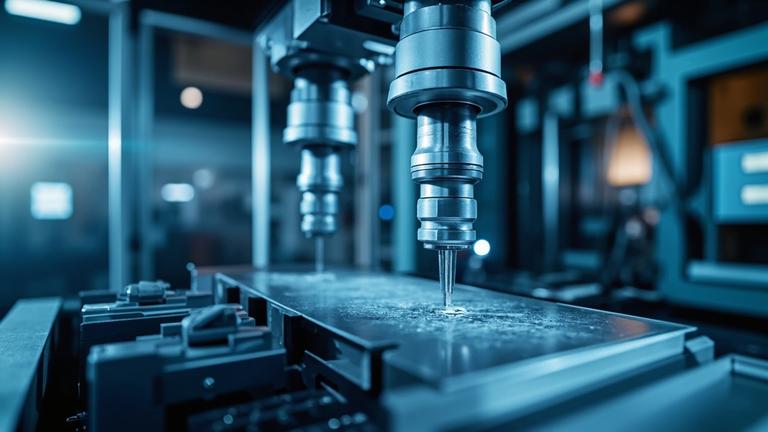
Self-Learning CNC Controllers with Real-Time Vibration Damping: The Future of Precision Machining Vibration remains one of the most persistent obstacles in high-speed CNC machining, particularly wh...
- By integrating high-frequency sensors and predictive algorithms, they detect and suppress chatter before it impacts part quality.
- - AI-driven algorithms predict and counteract chatter before it destabilises the cut, maintaining optimal machining conditions.
- 3.Extended Tool Life & Reduced Scrap Rates - By minimising vibration-induced stress, tools last longer, reducing replacement costs.
Vibration remains one of the most persistent obstacles in high-speed CNC machining, particularly when working with hard metals, composites, or intricate geometries. Chatter—unwanted oscillations between the tool and workpiece—leads to poor surface finish, accelerated tool wear, and even machine damage. Traditional vibration control methods, such as passive damping or fixed-parameter adaptive control, often fall short in dynamic machining environments where cutting conditions change rapidly.
The limitations of conventional CNC systems become especially apparent in aerospace, medical, and automotive applications, where micron-level precision is non-negotiable. Without intelligent, real-time adjustments, manufacturers face increased scrap rates, longer cycle times, and higher production costs.
How Self-Learning CNC Controllers Revolutionise Machining
Self-learning CNC controllers equipped with real-time vibration damping represent a breakthrough in machining technology. Unlike static control systems, these advanced controllers use artificial intelligence (AI) and machine learning (ML) to continuously analyse and adapt to machining conditions. By integrating high-frequency sensors and predictive algorithms, they detect and suppress chatter before it impacts part quality.
Key Advantages of Self-Learning CNC Controllers
1.Real-Time Adaptive Control
- Traditional CNC systems rely on pre-set parameters, which may not account for tool wear, material inconsistencies, or thermal effects.
- Self-learning controllers dynamically adjust spindle speeds, feed rates, and cutting depths in real time, optimising performance without manual intervention
2.Predictive Vibration Suppression
- Accelerometers and force sensors detect vibration frequencies as they emerge.
- AI-driven algorithms predict and counteract chatter before it destabilises the cut, maintaining optimal machining conditions.
3.Extended Tool Life & Reduced Scrap Rates
- By minimising vibration-induced stress, tools last longer, reducing replacement costs.
- Fewer rejected parts mean higher throughput and lower material waste.
4.Seamless Integration with Existing CNC Systems
- Many self-learning controllers can be retrofitted onto legacy machines, eliminating the need for full system replacements.
- Cloud-based learning allows controllers to share optimised parameters across multiple machines.
The Technology Behind Self-Learning Vibration Control
AI & Machine Learning in CNC Machining
Modern self-learning controllers employ neural networks trained on vast datasets of machining scenarios. Over time, they recognise patterns—such as the relationship between spindle load, harmonics, and tool deflection—and autonomously refine their responses.
Sensor Fusion for Enhanced Accuracy
- Accelerometers detect high-frequency vibrations.
- Force sensors monitor cutting resistance.
- Acoustic emission sensors identify tool wear before it affects performance.
By combining these inputs, the controller makes micro-adjustments at speeds beyond human capability.
Edge Computing for Instant Decision-Making
Unlike cloud-dependent systems, edge computing allows real-time processing directly on the machine. This eliminates latency, ensuring immediate corrections during high-speed operations.
Industry Applications & Performance Gains
Aerospace: Machining Thin-Wall Turbine Blades
Aircraft engine components demand extreme precision, yet their thin-walled structures are highly susceptible to vibration. Self-learning CNC controllers maintain stability, reducing scrap rates by up to 40% in some cases.
Medical: High-Precision Implant Manufacturing
Titanium and cobalt-chrome alloys present significant machining challenges. AI-driven damping ensures flawless surface finishes, critical for biocompatibility.
Automotive: High-Volume Production Without Compromise
For electric vehicle (EV) components like battery housings, vibration control ensures consistent quality across thousands of parts.
Economic Justification for Adoption
While the upfront cost of self-learning CNC systems may be higher than traditional controllers, the long-term benefits far outweigh initial investments:
- Reduced downtime – Fewer interruptions for manual adjustments or tool changes.
- Lower operational costs – Extended tool life and fewer defective parts improve ROI.
- Future-proofing – As AI models improve, so does machining efficiency without hardware upgrades.
Manufacturers already using this technology report productivity gains of 15-30%, along with significant improvements in part quality. In an industry where margins are tight and precision is paramount, self-learning CNC controllers are not just an innovation—they are becoming a necessity.
For those aiming to lead in high-precision manufacturing, the question is no longer whether to adopt intelligent CNC systems, but how quickly they can be implemented to secure a competitive edge.
- * * *
Simon McLoughlin
Is this your company?
This article features your business. Claim it to add your logo, contact details, and a link to your website — or upgrade to reach more buyers.
Did you know 80% of Press Releases trigger AI content warnings? Reach out and the M4S team can assist.