
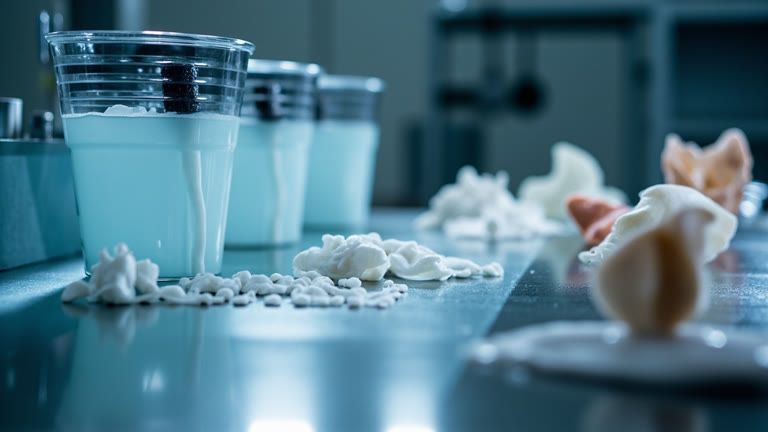
Materials Fight Additive manufacturing has conquered metals, thermoplastics, and ceramics.
- And healthcare regulation leaves no room for "close enough." For decades, silicone parts came from injection molding or casting.
- Clinicians needed silicone's performance without the manufacturing economics of 1950s mass production.
- > "The question was never whether silicone could be printed.
Additive manufacturing has conquered metals, thermoplastics, and ceramics. Silicone remained the holdout—until a French engineering team proved the skeptics wrong. The Problem: Why Silicone Resisted Printing
Silicone's properties make it indispensable in healthcare: chemical inertness, biocompatibility, durability under repeated sterilization. Those same properties made it nearly impossible to print. The material is too liquid to support its own weight during layer stacking. Its chemistry is sensitive—alter the crosslinking process and you compromise the very characteristics clinicians depend on. And healthcare regulation leaves no room for "close enough."
For decades, silicone parts came from injection molding or casting. Both work well at volume. Both fail at low-volume production, customized devices, or spare parts for legacy equipment—where tooling costs and lead times kill the business case. Clinicians needed silicone's performance without the manufacturing economics of 1950s mass production.
> "The question was never whether silicone could be printed. The question was whether it could be printed to a standard that clinicians would trust. That is what we have spent the last decade answering." > — Thomas Batigne, CEO, Lynxter The Solution: Material Extrusion at Micro-Dose Precision
Lynxter's answer is material extrusion, but not the coarse FDM most engineers picture. The system miniaturizes an injection pump into dual micro-dosing heads that combine silicone parts A and B at ratios accurate to 0.1 mL. Components meet in a static mixer during extrusion, crosslinking through chemical reaction alone—no heat input, no thermal degradation of material properties.
The real engineering work was process control. Liquid silicone has zero structural integrity between layers. Lynxter's platform governs chemistry parameters and print parameters simultaneously, keeping each extruded line in place until the next layer fuses on top. The breakthrough came from crosslinking gradually across layer groups rather than layer-by-layer, producing homogeneous parts with isotropic mechanical properties. The silicone performs consistently in every direction—matching injection molding behavior, which is rare in additive manufacturing and essential for regulated applications.
Overhangs presented the remaining geometric challenge. Standard support structures don't work with liquid elastomers. Lynxter's S300X platform incorporates a water-soluble secondary support head, enabling complex healthcare geometries that would be impossible with conventional approaches.
The company offers two hardware platforms. The S600D is a modular system with interchangeable tool heads for thermoplastics, liquid elastomers, ceramic pastes, and experimental bio gels. The S300X—LIQ 21 | LIQ11 is purpose-built for silicone, with higher throughput and features engineered specifically for medical device production. From Student Project to Production Floor
Lynxter's origin traces to a student printer project at a French engineering school. Airbus identified the technology and placed an order in 2016, effectively founding the company. Based in Bayonne with 35 staff and a partner-driven international distribution model, Lynxter has concentrated on the segment most AM players avoided: liquid elastomers, silicone in particular. Results: What Clinicians Actually Get
The platform now produces end-use silicone parts that meet the durability and chemical inertia demands of clinical environments. Isotropic mechanical properties mean predictable performance under load. No heat input means no thermal history compromising material characteristics. Water-soluble supports mean complex geometries without post-processing damage.
For healthcare organizations, the practical impact is manufacturing flexibility: customized devices, low-volume production, and spare parts without tooling economics dictating what is and isn't viable to produce. The material properties clinicians need, with the production economics that additive manufacturing promised twenty years ago.
Lynxter will present further technical details at AMA: Healthcare on June 4th.
Simon McLoughlin
Is this your company?
This article features your business. Claim it to add your logo, contact details, and a link to your website — or upgrade to reach more buyers.
Did you know 80% of Press Releases trigger AI content warnings? Reach out and the M4S team can assist.