
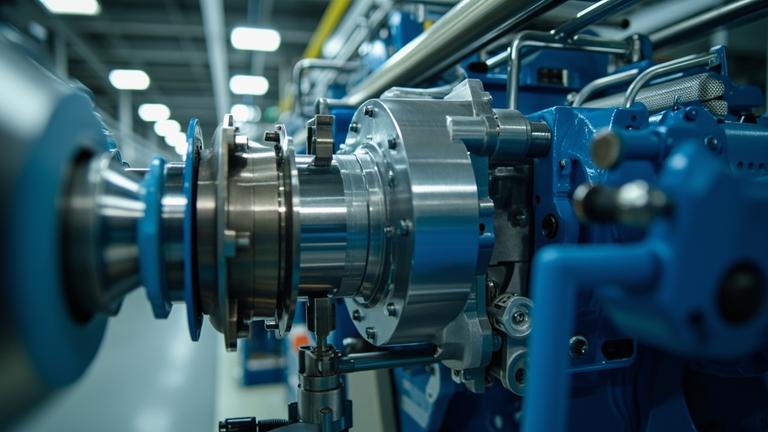
A student-built liquid-fueled detonation engine has successfully fired in Switzerland — a first for academic teams.
- The engine uses standard aviation fuel, not exotic propellants, making it practically useful
- Detonation engines offer 15-20% better fuel efficiency than conventional rocket engines
- Student projects are now tackling problems that national space agencies struggled with for decades
Joining an Elite Global Club A 20-person student team at ETH Zurich has pulled off something most national space agencies haven't: a stable, liquid-fueled rotating detonation rocket engine (RDRE) test. The Pegasus team, part of the Academic Space Initiative Switzerland (ARIS), recorded three distinct rotating detonation waves during a night firing at Dübendorf Airfield in early April 2026. Only around a dozen countries have reached this milestone. No student group had done it before. The Problem: Injecting Fuel into a Supersonic Wave RDREs don't burn fuel, they detonate it. A supersonic pressure wave spins around a ring-shaped combustion chamber at up to 20,000 revolutions per second, squeezing more energy from the same propellant than conventional steady combustion. The theoretical payoff is 10-20% better efficiency. That matters when fuel makes up 80-90% of launch mass. The catch: the injector has to mix propane and liquid oxygen and deliver it into that wave in under a millisecond. Get it wrong and the detonation propagates backwards into your supply lines. That's not a leak, that's an explosion. Mattia Röösli, a 21-year-old third-year mechanical engineering student, designed the injector. His process was iterative sketching, team review, calculation, prototyping, then metal additive manufacturing for the final part. No magic, just incremental work. "You don't need to be exceptionally talented to develop a rocket engine after two years of study," he said. "You go step by step and help each other." He was also direct about the limits of preparation: "It's a mistake to think you can fully understand the topic before you start. There are simply far too many unanswered questions." Two Attempts, Three Waves The first firing at 7 PM produced ignition but no confirmed detonation. The team pulled the sensor data, adjusted propane flow parameters, and fired again at 8:45 PM. This time the pressure wave shook the control hut door. A high-speed camera captured three distinct rotating detonation waves. Colleagues watching the feed beside the camera, outside the safety perimeter, validated the result in real time. Why Metal AM Isn't Optional Here The Pegasus injector is part of a wider pattern. Across RDRE programs at every level, from student teams to NASA and JAXA, metal additive manufacturing has become the step between concept and working hardware. The geometries involved — tight-tolerance injectors, integrated cooling channels, complex flow paths — aren't reliably producible through conventional machining. For RDREs, metal AM is a functional prerequisite, not a design preference. The Pegasus engine was built partly through ETH Zurich's Focus Projects curriculum, a two-semester program where teams of 5-10 students design and produce working hardware, and partly through industrial sponsorships. The team also drew on informal guidance from a commercial RDRE start-up sharing the same ETH hangar at Dübendorf, plus coaching passed down from previous ARIS cohorts. The Broader Context RDRE research has sustained interest from serious players. NASA, Polish national laboratories, and JAXA — still the only organization to have fired such an engine in space — are all active in the field. The Pegasus result doesn't put students ahead of those programs, but it does demonstrate that the barrier to entry for liquid-fueled detonation engine development is lower than the national-program count suggests. The hardware is hard. The process, as Röösli described it, is manageable.
Simon McLoughlin
Is this your company?
This article features your business. Claim it to add your logo, contact details, and a link to your website — or upgrade to reach more buyers.
Did you know 80% of Press Releases trigger AI content warnings? Reach out and the M4S team can assist.