
I have watched talented machinists spend 20-30 minutes per shift hunting for the right end mill or tap
- At a shop running two shifts with 15 operators, you're looking at 100-150 labor hours weekly just finding things
- That's not a minor inconvenience
The Problem: Hunting for Tools Eats Hours
I have watched talented machinists spend 20-30 minutes per shift hunting for the right end mill or tap. That adds up. At a shop running two shifts with 15 operators, you're looking at 100-150 labor hours weekly just finding things. That's not a minor inconvenience. It's a systematic drag on throughput that gets worse as inventory grows.
The real issue is that most storage solutions treat organization as an afterthought. You get a metal cabinet with some drawers. Maybe foam cutouts. Operators still have to remember where everything lives, and that memory degrades every time someone doesn't put something back exactly right.
Three manufacturers tackled this differently in recent product releases. Their approaches vary, but the engineering logic is worth examining.
KASTOsort Tower: Bidirectional Material Flow Changes the Equation
KASTO's sort tower addresses a specific bottleneck in saw operations. Traditional setup: warehouse feeds saw. Result: cut parts pile up waiting for manual sorting and storage.
The redesign allows the saw to feed the warehouse directly. Cut workpieces go straight into storage sorted by order. This eliminates a handling step and the errors that come with it.
The system runs continuously at 24/7 capacity. Storage density is higher than comparable vertical systems, though KASTO hasn't published exact figures per square meter. The ProControl system manages error-free operations, and the KASTOlogic mobile app provides real-time tracking.
I see the value here for shops running unmanned second shifts or weekend operations. The bidirectional flow means one operator can manage sawing and storage without constant intervention. AGV connectivity suggests they're thinking ahead for fully automated cells.
Sonic NEXT MSS: Modularity Without the Custom Premium
Sonic's approach differs. Instead of automating the storage itself, they focused on making the physical organization system more adaptable.
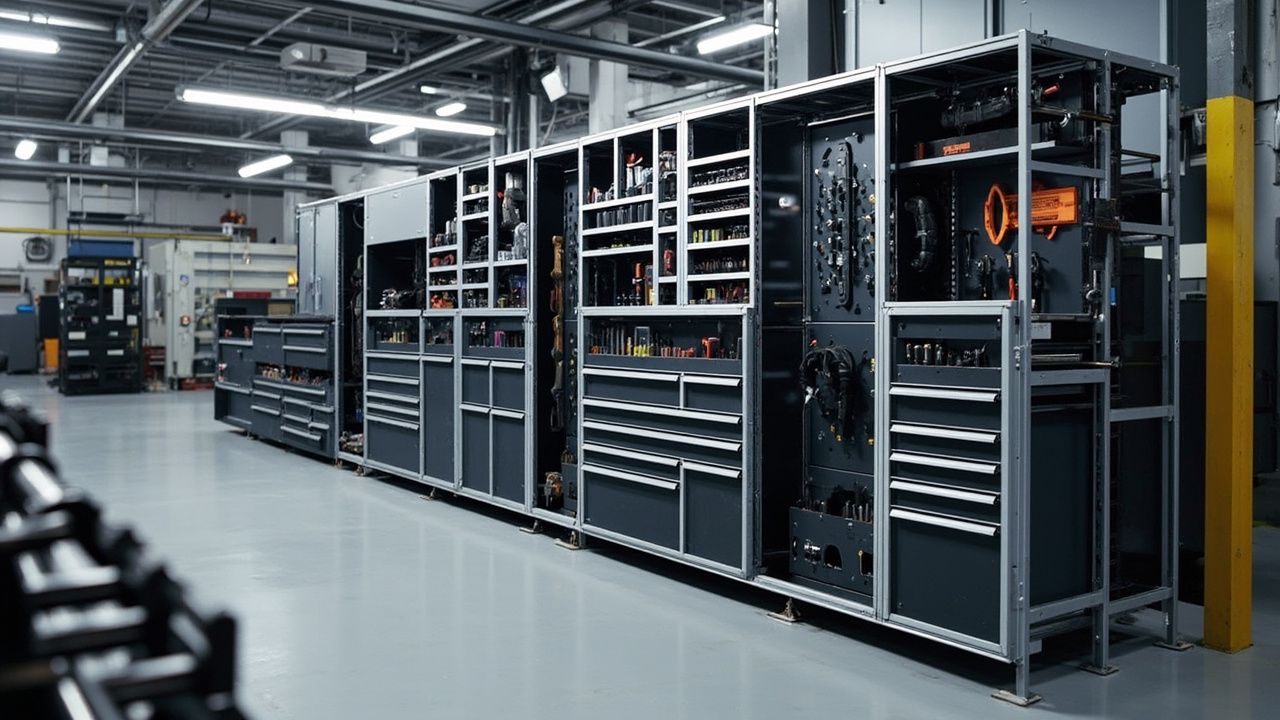
The NEXT MSS system offers over 60 module types: cabinets, worktops, back panels, accessories. Shop owners use the Sonic Configurator digital platform to design layouts before purchasing. This is practical. Seeing a 3D model of your planned setup catches interference issues before the cabinet arrives.
The Sonic Foam System integration provides 200+ preconfigured tool sets. Foam layouts are organized by tool type and size, which makes retrieval faster if you stick to the preset positions. The 10-year warranty suggests structural confidence, though I'd want to see the hinge cycle ratings before specifying this for high-volume cells.
The weakness: this system still depends on human discipline. No sensor tracking tells you when foam slots are empty. You still have to physically check inventory.
ZOLLER »keeper«: Digital Twin for Tool Inventory
ZOLLER takes the opposite approach. The »keeper« cabinet pairs physical storage with a 3D digital representation of your entire tool inventory.
Each insert is configured for specific tool types. The 3D view shows exactly where items are located. Warehouse bookings happen through the interface rather than paper logs. Analytics provide stock level data and usage patterns.
This directly addresses the search problem from the digital side. When a tool insert is empty, the system knows. Production planning can see tooling status without physical inventory counts.
The cabinet hardware includes adjustable feet and heavy-duty castors for uneven floors. That matters in older facilities where floor flatness tolerances aren't always met.
What This Means for Your Operation
These three systems represent different philosophies. KASTO automates material flow. Sonic modularizes physical organization. ZOLLER digitizes inventory tracking.
The best fit depends on your bottleneck. If operators are hunting for tools, ZOLLER's tracking solves that. If saw output is creating downstream chaos, KASTO's bidirectional flow helps. If your setup changes frequently, Sonic's configurator approach reduces reconfiguration time.
None of these are cheap. But the search time cost isn't free either. Calculate your actual lost hours before dismissing the investment.
RESULTS: Concrete Numbers Elusive
Manufacturers published limited performance data. KASTO cited award recognition but no specific throughput percentages. Sonic emphasized the 10-year warranty but didn't provide cycle ratings. ZOLLER's analytics are real, but the system requires initial calibration to match actual inventory.
I would want production trial data before specifying any of these for a critical application. The engineering concepts are sound. The documentation supporting specific performance claims needs work.
SUMMARY
This article examines three tool storage systems addressing the same root problem: shop floor search time consuming operator hours. Each takes a different engineering approach, and the right choice depends on whether your bottleneck is physical organization, material flow, or inventory tracking.
• KASTOsort tower enables bidirectional material flow between saw and storage, supporting 24/7 unmanned operation with AGV connectivity for automated cells • Sonic NEXT MSS offers 60+ module types with 3D configurator design tool and 200+ foam layouts, backed by 10-year structural warranty • ZOLLER »keeper« provides 3D digital twin of tool inventory with analytics for stock tracking and production planning, but requires initial calibration investment • Actual performance data remains sparse from all three vendors; published specs lack cycle ratings, throughput percentages, and error rate metrics • Economic justification requires calculating shop-specific search time costs against system pricing, which varies by configuration and should be requested directly from manufacturers
Simon McLoughlin
Is this your company?
This article features your business. Claim it to add your logo, contact details, and a link to your website — or upgrade to reach more buyers.
Did you know 80% of Press Releases trigger AI content warnings? Reach out and the M4S team can assist.