
Validation The Problem: Speed Without Proof Additive manufacturing has spent a decade chasing print speed.
- The Royal Netherlands Navy learned this firsthand.
- The Dutch Air Force uses them for custom tools across helicopters, fighter jets, and cargo planes.
- Both need traceability, not just throughput.
Additive manufacturing has spent a decade chasing print speed. UltiMaker's own customers kept telling them the same thing: faster prints mean nothing if you cannot prove the part meets spec. For defence applications, this is not a nice-to-have. It is the difference between a part that passes inspection and one that grounds a helicopter.
The Royal Netherlands Navy learned this firsthand. They run UltiMaker S series printers to produce spare parts on-demand. The Dutch Air Force uses them for custom tools across helicopters, fighter jets, and cargo planes. Both need traceability, not just throughput. The Hardware: Factor 4 Plus
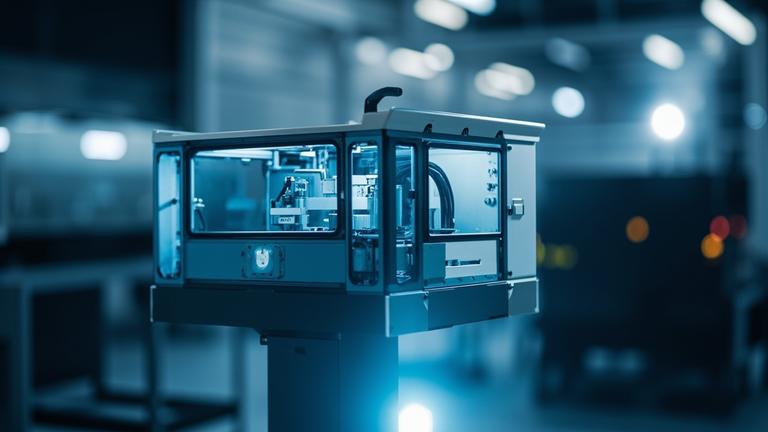
UltiMaker's answer is the Factor 4 Plus, an upgraded version of the Factor 4 with a ruggedised chassis built for harsh or remote environments. The headline number is 2x print speed versus the base model. That speed comes from a new Cheetah motion planner, which smooths out abrupt directional changes that cause vibration and dimensional drift. The machine also accepts new AA+ and CC+ high-flow print cores.
The case is tougher. The motion is faster. But the real differentiator is software. TRACE: Validation at the Machine Level
UltiMaker TRACE, short for Technical Reporting And Certification Engine, records key print parameters continuously during the build. Extrusion behaviour. Chamber temperatures. The system compiles this into CAD-validation reports without manual intervention.
Arjen Dirks, UltiMaker's CTO, put it plainly: "When I talk directly with our customers, one message comes through consistently: speed is great, but proving the quality of the part is the real challenge. TRACE was built directly in response to that feedback."
The data comes straight from the hardware, not post-process estimates. For defence users, this matters. They have been clear that data security and trust separate UltiMaker from cheaper desktop FDM competitors. The company describes its approach as "building valuable systems with great software" rather than "box shifting." Materials and Applications
The Factor 4 Plus handles PPS-CF, a high-heat, chemical-resistant composite suited to end-use components. UltiMaker is targeting custom jigs and fixtures, spare parts, tooling, and production components across industrial sectors.
Defence remains the priority use case. Remote bases cannot wait for supply chains. A printer that validates its own output reduces risk where failure is not an option. What It Means
This is a shift in how desktop FDM positions itself. UltiMaker is not competing on price. It is competing on audit trails. TRACE turns the printer into a quality system, not just a fabrication tool. Whether that justifies the premium over standard Factor 4 units depends on whether your application actually requires certifiable output.
For defence and regulated industries, the answer is probably yes. For everyone else, the base Factor 4 likely still does the job.
Simon McLoughlin
Is this your company?
This article features your business. Claim it to add your logo, contact details, and a link to your website — or upgrade to reach more buyers.
Did you know 80% of Press Releases trigger AI content warnings? Reach out and the M4S team can assist.