
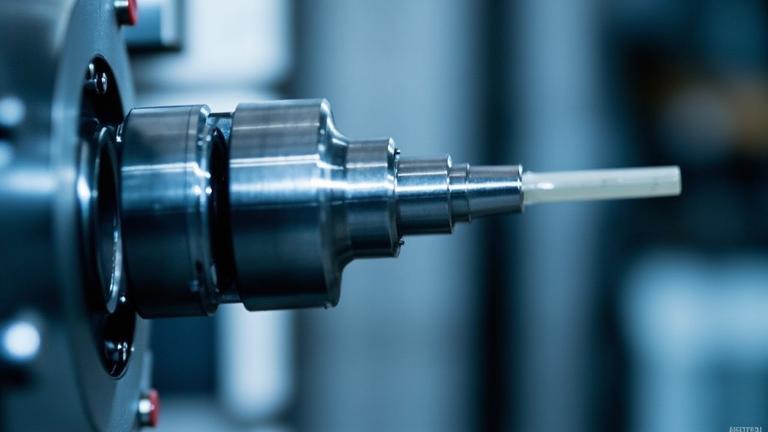
Ultra-precision air bearing spindles are becoming non-negotiable for manufacturers chasing sub-micron tolerances—mechanical bearings hit hard physical limits that directly translate to scrap and rework. • Surface finish targets have tightened to Ra 0.1 μm with dimensional tolerances of ±2 μm or better on hardened materials
- Aerospace fuel injectors, ophthalmic moulds, and microfluidic devices all demand sub-micron form accuracy plus burr-free edges at production scale
- Rolling element spindles fail because contact friction generates vibration at critical speeds and thermal growth distorts tool paths during long runs
- The cumulative result of mechanical bearing limitations: tool chatter, premature wear, and inconsistent part quality that conventional spindles cannot overcome
Ultra-Precision Air Bearing Spindles for Micro-Milling Applications: Redefining the Boundaries
The relentless drive towards miniaturisation across industries—from medical devices to aerospace components—has exposed the limitations of conventional spindle technology in micro-milling operations. Ultra-precision air bearing spindles have emerged as the critical enabler for machining features measured in single-digit microns, offering unmatched rotational accuracy and vibration-free performance that mechanical bearings simply cannot match.
This examination explores how advanced air bearing spindle technology addresses fundamental challenges in micro-milling, the engineering principles behind their superior performance, and their transformative impact on high-value precision manufacturing.
The Precision Demands of Modern Micro-Milling
Contemporary micromachining applications routinely require surface finishes below Ra 0.1 μm and dimensional tolerances tighter than ±2 μm across hardened materials. Aerospace fuel injector nozzles, ophthalmic lens moulds, and microfluidic devices all share common requirements: sub-micron form accuracy, burr-free edges, and consistent repeatability across production runs.
Traditional rolling element bearing spindles struggle to meet these demands due to inherent limitations. Contact friction induces vibration at critical speeds, while thermal growth distorts tool paths during prolonged operations. The cumulative effect manifests as tool chatter, premature wear, and inconsistent part quality—problems that become exponentially more damaging as feature sizes shrink below 100 μm.
Air Bearing Technology: Principles of Operation
Ultra-precision air bearing spindles eliminate mechanical contact through a pressurised air film, typically maintained at 4-6 bar. This hydrodynamic or aerostatic suspension provides several distinct advantages for micro-milling applications. Radial and axial runout values below 0.1 μm ensure cutting tools maintain positional accuracy impossible with ball bearing systems, directly translating to improved surface finish and edge definition.
The absence of stiction—a persistent issue in mechanical bearings at low speeds—enables exceptional speed stability across the entire operating range (5,000 to 120,000 RPM). This proves particularly valuable when machining brittle materials like germanium or silicon, where consistent chip load management prevents fracture initiation.
Advanced designs incorporate porous media bearings rather than traditional orifice-fed systems. This innovation distributes air flow more evenly, eliminating the pressure variations that can cause minute tool displacement during delicate operations. The result is cutting stability that persists even when employing micro-tools below 0.3 mm diameter.
Critical Performance Factors for Micro-Machining
Thermal management represents perhaps the most significant differentiator among air bearing spindle designs. High-performance systems integrate active cooling channels that maintain housing temperatures within ±0.5°C—critical when holding 1 μm tolerances over multi-hour machining cycles. Some implementations go further, employing predictive thermal compensation algorithms that adjust tool paths based on real-time temperature telemetry.
Dynamic stiffness, often exceeding 50 N/μm in premium spindles, determines achievable surface finishes in challenging materials. This parameter becomes particularly crucial when machining hardened tool steels or tungsten carbide, where cutting forces—though minuscule—can still deflect insufficiently rigid systems. Modern finite element analysis techniques optimise bearing geometries to maximise stiffness without compromising the damping characteristics that suppress high-frequency vibration.
Tool interface technology has evolved in parallel with spindle advancements. High-precision ER collet chucks with balanced gripping mechanisms now achieve TIR (Total Indicated Runout) values below 1 μm at the tool tip—a necessity when working with micro-end mills where even slight misalignment can double effective cutting diameters.
Industry Applications Demonstrating Transformative Results
The medical device sector provides compelling evidence of air bearing spindles' capabilities. Machining titanium bone screw threads with 20 μm pitch requires not just exceptional spindle accuracy but also rapid acceleration/deceleration to maintain productivity. Modern direct-drive air bearing systems achieve 0 to 60,000 RPM in under two seconds, enabling complex micro-features without compromising cycle times.
In optical manufacturing, freeform surface generation on infrared lens moulds demands both nanometric surface finishes and sub-arc-minute contouring accuracy. Air bearing spindles paired with ultra-precision 5-axis platforms now produce optical surfaces requiring minimal subsequent polishing—a breakthrough that slashes lead times for military-grade night vision components.
The electronics industry benefits similarly when producing micro-cooling arrays for high-power semiconductors. Copper micro-fin structures with 50 μm wall thickness and 15 μm corner radii are machined reliably only through the combination of air bearing spindles and advanced tool path strategies that account for tool deflection at this scale.
Implementation Considerations for Production Environments
Integrating air bearing spindles into existing machine tools requires careful attention to ancillary systems. Air preparation demands multi-stage filtration to 0.01 μm absolute—contaminants at this scale can disrupt the bearing gap and cause catastrophic failure. Vibration-isolated bases become mandatory to prevent floor-borne oscillations from negating the spindle's inherent stability.
Maintenance protocols differ significantly from mechanical spindle practices. While air bearings themselves are virtually wear-free, the compressor systems supplying them require meticulous moisture control and particulate monitoring. Predictive maintenance regimes using vibration analysis and air quality sensors have proven effective in preventing unplanned downtime.
Cost justification must consider total process economics rather than just capital expenditure. The ability to hold ±1 μm tolerances without post-process inspection—combined with 3-5x longer tool life from vibration-free operation—often delivers ROI within 18 months for high-value micromachining applications.
The Strategic Advantage in Precision Manufacturing
For manufacturers competing in markets where micron-level precision commands premium pricing, ultra-precision air bearing spindles represent more than an equipment upgrade—they enable entirely new product categories. The technology removes previous design constraints around micro-feature size and complexity, opening opportunities in micro-optics, minimally invasive surgical tools, and micro-electromechanical systems (MEMS).
The data-rich nature of modern air bearing systems provides additional competitive uses. Integrated sensors monitor bearing gap, temperature, and vibration in real time, creating digital twins of every machining operation. This wealth of process intelligence supports continuous improvement initiatives and provides irrefutable quality documentation for aerospace and medical customers.
As additive manufacturing reaches its resolution limits for metallic micro-components, subtractive processes using air bearing technology are experiencing renewed relevance. The ability to machine features smaller than 50 μm in hardened materials—with surface finishes that eliminate secondary processing—positions micro-milling as a complementary rather than competing technology to 3D printing.
For operations where precision defines product performance and profitability, ultra-precision air bearing spindles have transitioned from luxury to necessity. Their capacity to consistently produce micron-accurate features at production volumes creates a formidable barrier to entry for competitors relying on conventional spindle technology—an advantage that will only widen as tolerances continue tightening across advanced manufacturing sectors.
- * * *
Simon McLoughlin
Is this your company?
This article features your business. Claim it to add your logo, contact details, and a link to your website — or upgrade to reach more buyers.
Did you know 80% of Press Releases trigger AI content warnings? Reach out and the M4S team can assist.