
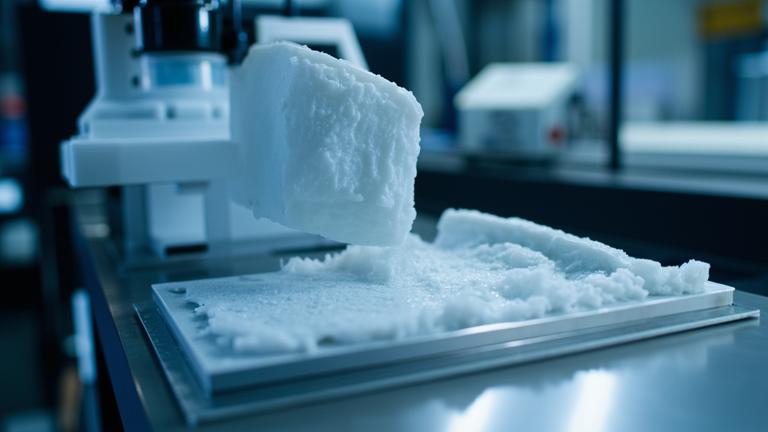
Volumetric bioprinting is not an incremental improvement. It is a
- Structural departure that collapses build times from hours to seconds,
- But the field still faces a hard limit at 100-200 microns without
- Vascular architecture. For engineers working in tissue engineering or
- Medical device development, the speed gains are real and the
- Vascularization problem is now the central technical challenge.
- 12.
Seconds, But Vascularization Remains the Hard Ceiling The Speed Problem Nobody Solved—Until Now
Tissue engineers have lived with the same three constraints for over a decade: models take hours or days to print, scaling production is nearly impossible, and the finished structures lack the internal architecture of real tissue. Oksana Dudaryeva, formerly a postdoctoral researcher at University Medical Center Utrecht, has spent her career attacking all three simultaneously.
Her latest work on volumetric generation of complex tissue-engineered liver systems, conducted in the lab of Riccardo Levato, makes a case that volumetric printing is not an iteration on existing bioprinting. It is a fundamentally different approach.
Conventional bioprinting builds layer by layer. Volumetric printing projects multiple light angles onto a rotating vial filled with photo-responsive solution. The projections converge into a three-dimensional hologram that solidifies in seconds to minutes. The speed advantage over DLP or extrusion-based methods is not marginal. It is substantial.
"Volumetric printing is not an iteration on what came before," Dudaryeva said. "It collapses the time and structural limitations that have defined bioprinting from the start." What It Can Already Build
The Levato lab has produced tissue constructs that would be impractical or impossible through other means. A trabecular bone model, one centimeter in diameter and incorporating human mesenchymal stem cells, endothelial cells, and small internal vessels, printed in 12.5 seconds. A liver-on-a-chip organoid embedded in perfusable hydrogel demonstrated functional ammonia elimination in testing.
More recently, the group developed a pancreas model using beta cell-like spheroids capable of insulin production. Ongoing work targets Langerhans islets derived from pluripotent stem cells expressing PDX1, a key endocrine marker, for drug testing applications.
But Dudaryeva is direct about the limitation these models share.
"Each of these models demonstrates what the technology can do," she said. "What many other models still lack is the vascular architecture that makes tissue actually function."
None yet includes the dense, hierarchical vascular networks that real tissue depends on for oxygen delivery, nutrient exchange, and cellular signaling. Why Vascularization Is the Blocking Issue
Vascularization is not a secondary problem in tissue engineering. It determines whether a model behaves like living tissue at all.
"The hydrogels we use are simply not porous enough by default," Dudaryeva said. "Without porosity, cells cannot infiltrate, vessels cannot form, and the construct hits a hard size limit. That is the problem we set out to solve."
Standard synthetic hydrogels, including PEG-diacrylate, PEG-methacrylamide, and gelatin-methacrylamide, all crosslinked with light and a photoinitiator, are stable and printable. They are also nanoporous by default. Unless void spaces are physically printed into the structure, cells cannot move through them and vessels cannot form. The result is a hard ceiling on construct size at roughly 100 to 200 microns, beyond which oxygen diffusion fails. The Phase Separation Fix
Dudaryeva's solution draws from her research on macroporous materials created by liquid-liquid phase separation. Developed with researchers at ETH Zurich, the approach introduces phase-separating agents, polysaccharides such as dextran that do not participate in crosslinking, into the hydrogel formulation.
Their presence triggers phase separation during crosslinking.
Simon McLoughlin
Is this your company?
This article features your business. Claim it to add your logo, contact details, and a link to your website — or upgrade to reach more buyers.
Did you know 80% of Press Releases trigger AI content warnings? Reach out and the M4S team can assist.