
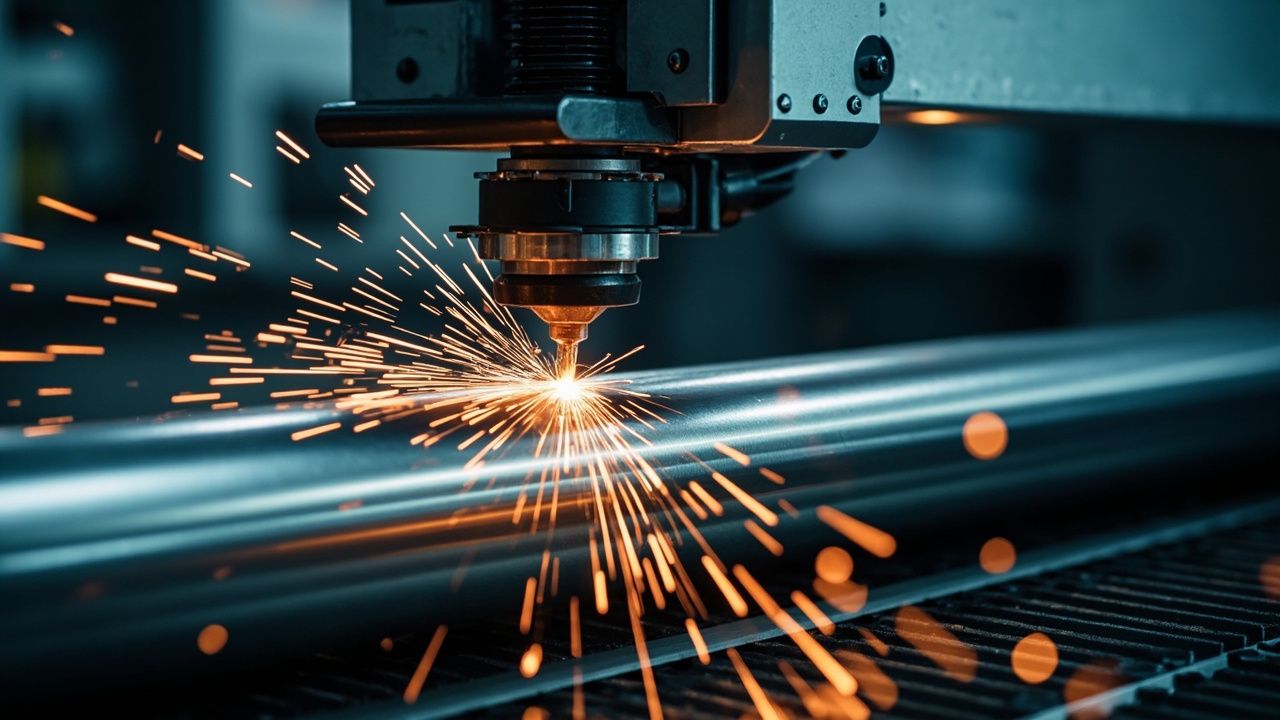
Compensation systems transform tube laser cutting from a "cut where programmed" operation into an adaptive process that accounts for real material conditions
- The technology is mature and the economic case is straightforward for shops running production volumes above 500 parts per month
The gap between tube laser shops that consistently hit tolerances and those chasing scrap rates comes down to one thing: how they handle material reality versus CAD idealization.
Modern tube laser cutting has become load-bearing for manufacturers chasing lightweight, high-strength geometries. The process delivers speed and flexibility that stamping and machining can't match on complex profile cuts. But here's what the vendor brochures won't tell you: even the most sophisticated tube laser systems fail when fed real-world materials.
The Problem Nobody Talks About
Tubes arrive at the cutting station carrying baggage. Bow, twist, weld seam variation, and dimensional drift are the norm, not the exception. A tube spec'd as 50mm might measure 49.87mm at one end and 50.12mm at the other. The weld seam sits 2-3 degrees off-center more often than not. Your CAD model assumes perfect geometry. Your material doesn't read it.
Without compensation, a tube laser cuts where the program says to cut, not where the tube actually is. This creates cascading downstream problems: parts that don't fit robotic welding fixtures, assemblies requiring hand fitting, and operators spending hours deburring geometry that was never right to begin with.
"We measured 0.8-1.2mm of bow across a 6-meter batch of HSS structural tube. Without compensation, every cut on that material was wrong by at least that amount."
What Compensation Actually Does
Compensation in tube laser work means the system measures the tube's actual condition before cutting, then adjusts the cutting path accordingly. This isn't post-cut inspection and rework. It's preemptive adaptation built into the machining strategy itself.
The compensation layers that matter:
Dimensional compensation adjusts for the difference between nominal tube OD/ID and actual measurements. A tube measured at 49.92mm needs a different cut path than one measured at 50.08mm, even if both carry the same 50mm specification.
Centerline compensation corrects feature placement when the tube's center axis doesn't align with machine coordinates. This matters heavily on multi-face features where hole locations must land precisely on specific faces relative to the weld seam.
Bow compensation accounts for straightness deviations. A 6-meter tube with 1.5mm of bow requires different treatment than one with 0.3mm of bow, even when both meet standard tolerance specs.
The key is per-tube measurement. Batch sampling misses the variation that occurs tube-to-tube and bar-to-bar within a single shipment.
Why Operator Experience No Longer Cuts It
Traditional shops relied on operator knowledge to compensate. A skilled machinist learned how specific materials behaved and manually adjusted programs. This worked when shops ran consistent materials from stable suppliers.
That model breaks under modern conditions. High-mix production means materials change constantly. Workforce turnover transfers tribal knowledge out the door. Shift-to-shift variation creates quality fingerprints that customers refuse to accept.
Automated compensation removes the human dependency. Systems now measure, calculate, and adjust without operator intervention. This doesn't eliminate the operator's role, but it changes it from "compensate by feel" to "verify the system compensates correctly."
The real payoff is in measuring intelligently. Over-measurement adds cycle time. Under-measurement produces scrap. Modern systems apply measurement density where variability is highest and back off where material behaves predictably.
The Numbers Tell the Story
Shops implementing full compensation stacks report measurable improvements. Typical results on structural tube work:
- 40-60% reduction in first-pass scrap on new material qualifications
- 15-25% decrease in per-part cycle time versus fixed-program cutting
- Rework hours drop by half or more on high-tolerance assemblies
The investment in measurement hardware and software typically pays back within 12-18 months on medium-volume structural work. The real value isn't the ROI calculation though. It's the ability to take on work that requires tolerances previously considered impossible for tube processing.
Simon McLoughlin
Is this your company?
This article features your business. Claim it to add your logo, contact details, and a link to your website — or upgrade to reach more buyers.
Did you know 80% of Press Releases trigger AI content warnings? Reach out and the M4S team can assist.