
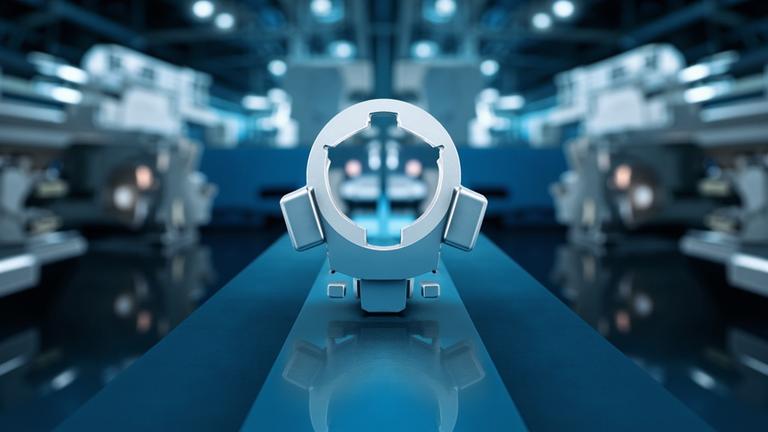
Throughput claim: The system reaches up to 4.24 cm³/h at 40 μm, supported by recoating, purging and chamber-sealing updates.
- Updated platform: Addireen’s XH-M350G-2HR targets series production of pure copper and copper alloys with 500 W and 1KW green-laser configurations.
- Stability focus: Revised optics, active temperature control and separated chamber airflow address long-build drift, smoke, spatter and window deposits.
- Production evidence: The XH-M350G series has logged more than 100,000 printing hours, including a 140-hour build of approximately 400 optical-transceiver heat sinks.
- Workflow expansion: AddireenNow links quoting, engineering support, printing, post-processing and inspection, backed by over 100 AM systems and more than 20 downstream systems.
Addireen has unveiled an updated XH-M350G-2HR metal 3D printing system aimed at the series production of pure copper and copper alloys. The pitch is not novelty; it is throughput, repeatability, and control over long builds.
The machine pairs green lasers with configurations of 500 W and 1KW, a build volume of 350 × 350 × 550 mm, and parameter settings for 30, 40 and 80 μm layer thicknesses. Addireen says the pure-copper build rate reaches up to 4.24 cm³/h at a 40 μm layer thickness, while bidirectional variable-speed recoating, updated purging and chamber sealing cut the time spent preparing each new layer.
Long-run stability is the real update
The engineering emphasis is on holding conditions steady when the build runs long. Addireen has revised the optical path and added active temperature control to reduce thermal drift. The chamber uses separate airflow levels to remove smoke and spatter from the powder-bed area and to limit deposits near the protective window.
That matters because copper work is rarely a short demonstration print. The XH-M350G series has logged more than 100,000 printing hours, and a recent 140-hour build produced approximately 400 pure-copper heat sinks for optical transceivers on a single build plate, with local wall thicknesses below 0.5 mm.
“For our customers, scaling up copper AM means producing more parts per build, sustaining reliable operation over long production cycles and maintaining consistent quality from batch to batch. The third-generation XH-M350G-2HR focuses on these production priorities to help customers scale their pure-copper manufacturing with confidence.”
The process story is also about data. The system records laser power and chamber oxygen for process review and traceability, giving production teams a record they can audit rather than a finished part they have to interrogate after the fact.
Addireen is targeting applications where thermal or electrical conductivity is critical: liquid cold plates, heat exchangers, aerospace combustion chambers and similar copper hardware. The green-laser route is central here because pure copper absorbs green light far more readily than conventional near-infrared wavelengths at room temperature; paired with a focused spot diameter of 40–60 μm, the process is positioned for fine-feature development without pretending copper is suddenly easy.
Quoting moves closer to the machine
Alongside the printer update, Addireen introduced the AddireenNow automated quotation platform. It combines automated quoting with engineering support, metal 3D printing, post-processing and inspection, which is an acknowledgment that copper AM programs often fail in the handoffs rather than in the melt pool.
“Customers need more than an as-printed part. They need a part that meets defined dimensional, surface and functional requirements,” said Xu. “AddireenNow brings the manufacturing steps into one workflow, from the initial model review through post-processing and inspection.”
The production backbone is substantial on paper: more than 100 metal additive manufacturing systems and over 20 post-processing and quality-assurance systems. For manufacturing engineers, the significance is less a single specification than the attempt to tie build rate, layer preparation, optical stability, traceability and downstream operations into one production argument.
The open question is consistency outside Addireen’s own evaluated conditions.
Is this your company?
This article features your business. Claim it to add your logo, contact details, and a link to your website — or upgrade to reach more buyers.
Did you know 80% of Press Releases trigger AI content warnings? Reach out and the M4S team can assist.