
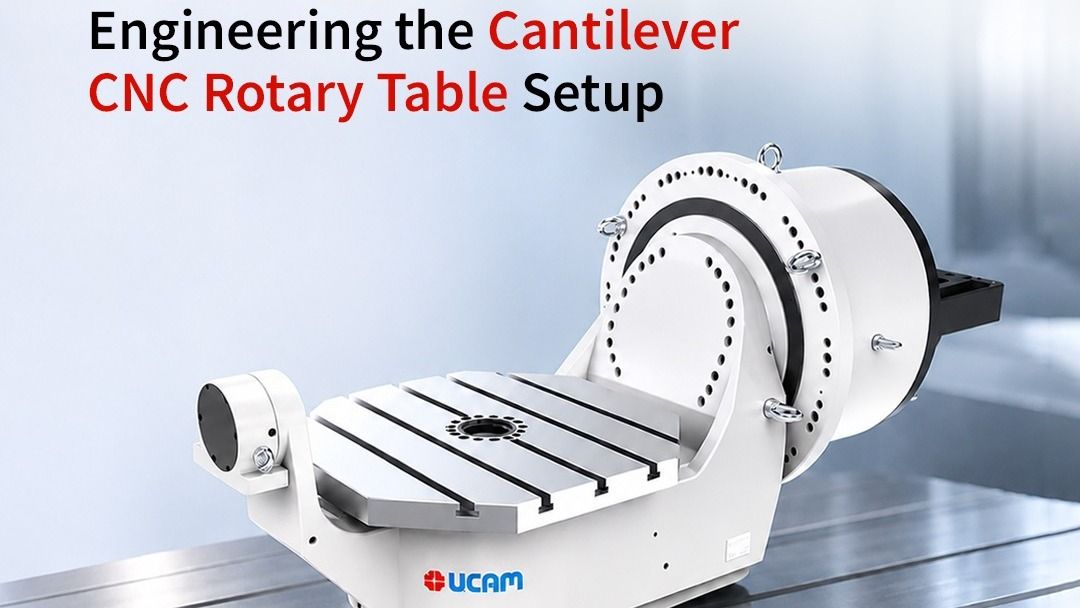
UCAM splits its SQ600CT series into three drive architectures for single-side workholding.
Standard workholding uses a tailstock to support long or heavy parts, but asymmetrical geometry obstructs opposite-end support, forcing single-side clamping. For that case UCAM offers the SQ600CT series in three drive architectures: a dual lead worm gear mechanism on the URH, a worm gear tilt axis with a direct drive rotary axis on the URD, and torque motors on both axes for the UDD.
UCAM now offers the SQ600CT series in three configurations for Cantilever CNC Rotary Table work, where a tailstock cannot reach the part.
When a tailstock cannot be deployed, workholding must support the whole workpiece from one side, creating off-center payload machining. Cantilever setups require axial-radial cross-roller bearings, whose cylindrical rollers sit in an alternating, perpendicular crisscross pattern to absorb multidirectional forces simultaneously.
High-pressure hydraulic clamping systems are mandatory for high holding torque. The URH SQ600CT uses a dual lead worm gear mechanism for heavy roughing; the URD pairs a worm gear tilt axis with a direct drive rotary axis; the UDD uses torque motors on both axes for 5-axis work.
Frequently asked questions
What mechanical components are critical for a CNC rotary table to handle off-center machining of asymmetrical parts?
To counteract the severe bending moment generated by off-center payloads, cantilever CNC rotary tables require two foundational mechanical pillars. Firstly, highly pre-loaded axial-radial cross-roller bearings are essential. These bearings, with their alternating, perpendicular roller arrangement, absorb multidirectional forces simultaneously, neutralizing bending moments and holding the unsupported part rigidly. Secondly, extreme braking friction is mandatory, typically achieved through high-pressure hydraulic clamping systems that apply massive friction to lock the axis, preventing slippage during heavy metal removal.
How does a dual lead worm gear mechanism on a cantilever rotary table benefit heavy-duty roughing operations?
The dual lead worm gear mechanism, utilized in the URH SQ600CT configuration for heavy-duty roughing of steel forgings or cast iron, provides immense torque multiplication to counteract gravity on asymmetrical loads. A key benefit is its wear compensation capability. As the gears naturally wear under extreme loads, the dual-lead design allows maintenance engineers to micro-adjust the gear mesh, permanently restoring the table to zero-backlash factory tolerances and ensuring long-term precision despite the demanding operational conditions.
What are the key advantages of using a cantilever CNC rotary table for asymmetrical component machining in advanced manufacturing sectors?
Integrating a cantilever CNC rotary table addresses critical challenges in machining asymmetrical components, such as those found in aerospace, energy, and medical devices. These tables enable the processing of highly irregular parts in a single automated setup, avoiding fixture interference and multiple manual setups that compromise concentricity. By providing a stable workholding solution for parts where traditional tailstock support is physically obstructed, they allow for precise machining with minimal deflection and tool chatter.
When should a hybrid drive architecture featuring a direct drive rotary axis be specified for a cantilever setup?
A hybrid architecture, such as the URD SQ600CT, pairing a heavy-duty worm gear tilt axis with a direct drive rotary axis, should be specified when a balance of aggressive tilting support and high-speed rotational contouring is required. This configuration is ideal for components demanding both the mechanical locking torque to safely suspend heavy cantilevered loads and the instantaneous acceleration and ultra-high RPMs of a gearless magnetic torque motor for drastically reduced cycle times.
What is the primary advantage of a full direct drive rotary table configuration for precision machining tasks?
The UDD SQ600CT configuration, utilizing torque motors on both axes, represents the ultimate precision choice for tasks like turbine blade manufacturing or medical implant machining. By eliminating internal gearing entirely, this Direct Drive Rotary Table achieves zero mechanical backlash and zero physical friction. This enables a flawless, continuous 5-axis simultaneous machining setup for complex spatial contouring on unsupported components, prioritizing surface finish and geometric perfection above all else.
How does the UCAM SQ600CT series cater to the diverse needs of asymmetrical part machining?
The UCAM SQ600CT series is engineered specifically for cantilever applications and addresses the wide range of asymmetrical parts encountered in advanced manufacturing. It offers three distinct drive architectures: the heavy-roughing standard with a dual lead worm gear, the hybrid architecture with a direct drive rotary axis, and the ultimate precision full direct drive rotary table. This variety allows production engineers to select the drive mechanism that precisely matches the physics and requirements of their specific cutting operations.
Get the long read at UCAM Pvt. Ltd.
Is this your company?
This article features your business. Claim it to add your logo, contact details, and a link to your website — or upgrade to reach more buyers.
Did you know 80% of Press Releases trigger AI content warnings? Reach out and the M4S team can assist.