
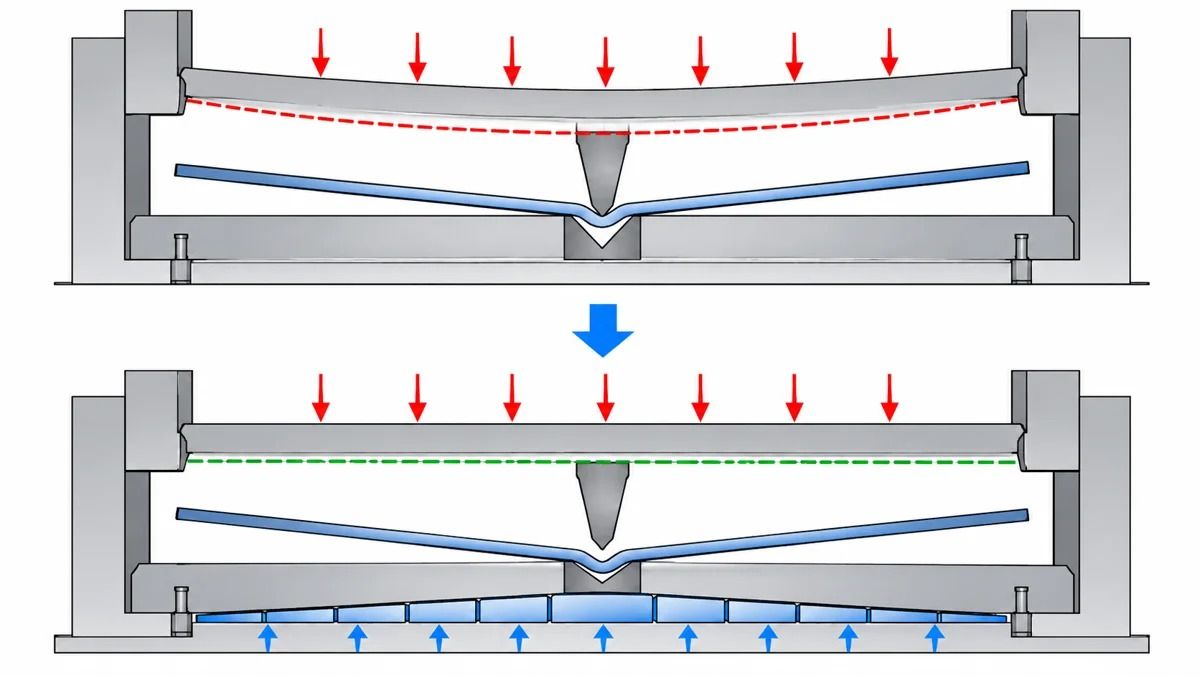
RAYMAX press brake crowning system compensates for ram and bed deflection during bending.
The system adjusts the lower tooling support to counter ram and bed deflection under load. Manual and motorized wedge designs are described, with CNC-linked compensation available on compatible controls. Without enough compensation, long sheets can bend more openly at the center than the ends, so test bends and multi-position checks remain necessary.
RAYMAX describes manual and CNC-adjustable wedge systems on its own press brake crowning system page.
When bending force is applied, the ram and bed deform slightly under load, changing the punch-to-die relationship along the bend. Without enough compensation, the center of a sheet can show a more open angle than the ends. A crowning system introduces a controlled compensation profile to reduce that variation.
A center angle of 91.2° while the ends sit close to target may suggest insufficient crowning. Adjust the setting per the machine manufacturer’s instructions, then repeat the test bend and measure again. Material variation, tooling condition, and uneven loading may still require correction.
Frequently asked questions
How can press brake crowning systems be adjusted to correct angle variations across a workpiece?
Press brake crowning systems correct angle variations by introducing a controlled compensation profile to counteract the natural deflection of the ram and bed during bending. In mechanical systems, adjustable wedges create an upward compensation curve. Manual systems require operator adjustment, while motorized versions can integrate with CNC controllers to automatically apply compensation values based on programmed bending conditions. Hydraulic systems use controlled hydraulic force to modify the support profile. Adjustment is typically performed according to the machine manufacturer’s instructions, with repeated bending and measurement to verify the correction.
What are the primary differences in maintenance and adjustment between mechanical and hydraulic crowning systems?
Mechanical crowning systems, often using adjustable wedges, can be adjusted manually or via a motorized system integrated with CNC controls. Their maintenance involves checking wedges, guides, drive components, and lubrication. Hydraulic crowning systems rely on hydraulic actuators or pressure-controlled supports, adjusted through hydraulic control. Maintenance for hydraulic systems includes checking hydraulic seals, pressure control, and actuators. Both systems can offer CNC integration, but selection priority for mechanical systems tends to be adjustment range and repeatability, while for hydraulic systems, it's pressure control and compensation range.
What critical factors should an engineer consider when evaluating and selecting a press brake crowning system for specific production needs?
When evaluating press brake crowning systems, engineers should confirm the crowning type (manual mechanical, motorized mechanical, or hydraulic) and its control method, whether manual or CNC-integrated. The adjustment range must accommodate the machine’s intended bending conditions. It is crucial to verify bending performance through demonstrations with the user's actual workpiece, measuring angles along the part. Finally, maintenance aspects such as calibration procedures, service access, and the availability of replacement parts should be thoroughly investigated.
What types of workpieces or applications benefit most from press brake crowning?
Crowning systems become particularly important when bending longer workpieces under substantial load. Typical applications include electrical cabinet panels, long sheet metal enclosures, structural profiles, and heavy-duty plate components where consistent angles across the full length are critical. For very long parts, machine working length and synchronization also become important considerations.
Can crowning completely eliminate machine deflection during bending operations?
No, crowning systems do not stop the machine from deflecting. Instead, they compensate for the effect of that deflection on the finished bend. The system introduces a controlled compensation profile to reduce the variation in bend angles that would otherwise occur due to the ram and bed deforming under bending force.
What diagnostic clues can help identify if a crowning system needs adjustment?
Diagnosing a need for crowning adjustment involves measuring bend angles at the left end, center, and right end of a test piece. If the center angle is larger than both ends, it may indicate insufficient crowning. Conversely, a center angle smaller than both ends might suggest excessive crowning. Progressive angle changes from left to right could point to issues with Y1/Y2 synchronization, alignment, tooling, or uneven loading, while similar angle errors across the entire part might relate to bend depth, material variation, springback, or tooling.
Get the long read at Anhui Zhongrui Machine Manufactory Co.,Ltd.
Is this your company?
This article features your business. Claim it to add your logo, contact details, and a link to your website — or upgrade to reach more buyers.
Did you know 80% of Press Releases trigger AI content warnings? Reach out and the M4S team can assist.