
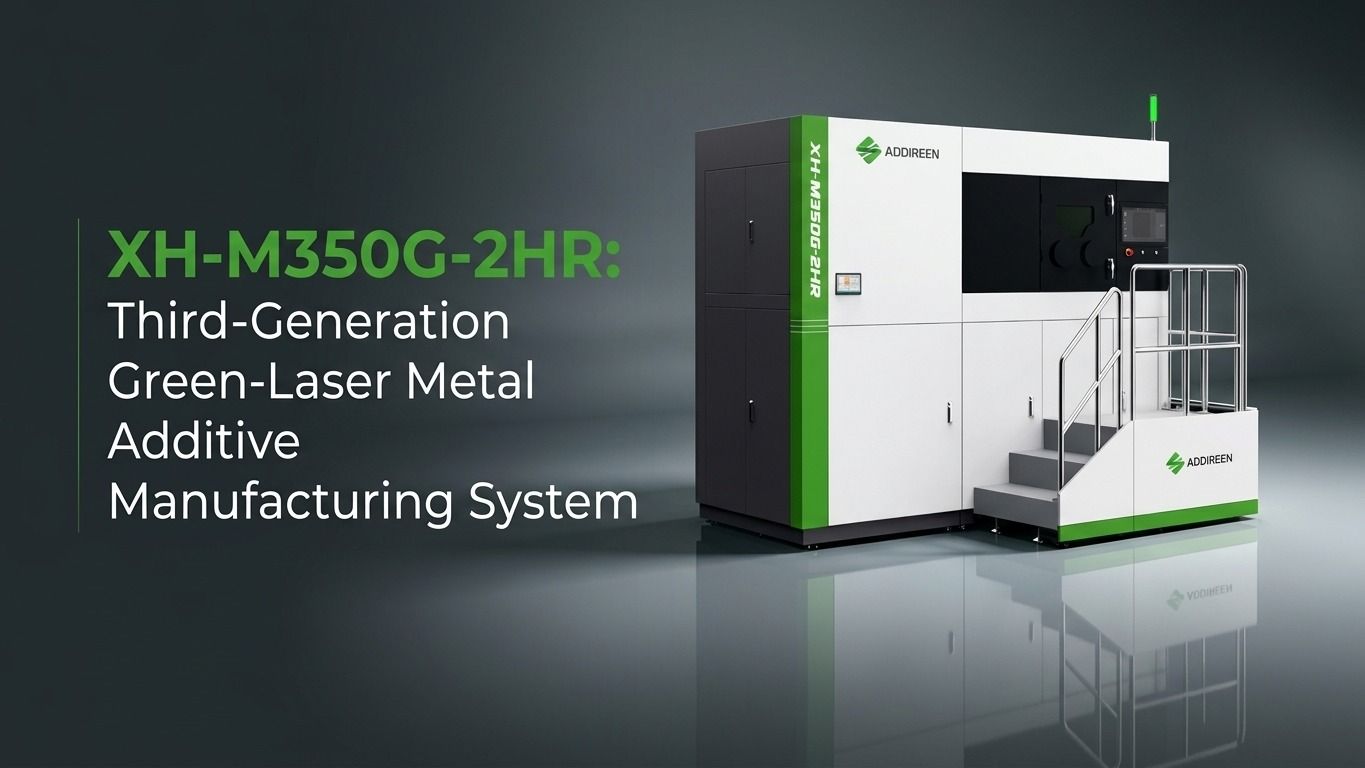
Addireen has updated the XH-M350G-2HR, a dual-green-laser metal additive manufacturing system for pure copper and copper alloys. The machine uses 532 nm lasers and a 350 x 350 x 550 mm build volume. Addireen reports a pure copper build rate up to 24.24 cm3/h at 40 micron layers. It has not stated component-level results for specific customer parts. The announcement covers the coupling advantage of green light with copper and the process variables that still affect finished components.
Paired green lasers produce dense copper components in the XH-M350G-2HR additive manufacturing system.
Pure copper reflects much of the incident laser energy and conducts absorbed heat away from the melt zone quickly. Green wavelengths couple more effectively with the metal under comparable conditions, giving melt formation a more controllable starting point.
Two configurations are offered: 2 x 500 W and 1,000 W. The build chamber takes multi-part layouts and full builds of thermal and electrical components.
Under defined process conditions, the reported results include relative density up to 99.9%, thermal conductivity up to 400 W/(m.K), electrical conductivity up to 101% IACS, and full-build dimensional consistency at Cpk above 1.33.
Powder-bed monitoring, process data recording, controlled airflow and temperature-managed optics are included to reduce variation across long builds and different areas of the build plate. Greater light absorption does not remove the need for process development. Powder quality, oxygen level, scanning parameters, thermal history and component geometry still affect density, surface condition and dimensional accuracy.
Addireen develops the light source, optical path, gas-flow system and processing parameters together, drawing on the green fibre laser experience of parent company Shenzhen Gongda Laser.
Copper is most relevant where heat must leave a concentrated source, including high-power electronic modules, AI computing hardware and compact optical systems. Printed internal geometry can combine cooling channels, TPMS structures, manifolds and heat-transfer surfaces in one component, reducing part count and removing brazed or welded interfaces.
A workable thermal design still has to balance surface area, coolant distribution, pressure drop, wall thickness, powder removal and mechanical strength - and the figures above are reported results under defined process conditions.
Frequently asked questions
Why does pure copper defeat conventional near-infrared lasers?
The full answer is in the original report. Read it at Addireen.
How much of the XH-M350G-2HR's copper performance comes from the green light?
The full answer is in the original report. Read it at Addireen.
Which thermal applications could use dense copper parts first?
The full answer is in the original report. Read it at Addireen.
Is this your company?
This article features your business. Claim it to add your logo, contact details, and a link to your website — or upgrade to reach more buyers.
Did you know 80% of Press Releases trigger AI content warnings? Reach out and the M4S team can assist.